
“I told the others, they didn’t believe me. You’re all doomed. You’re all doomed.”
Crazy Ralph, Friday the 13th Part 2
Pumpkin-spiced season’s greetings, HalloRe’ewinders! Rattle our rusty ol’ door knocker, crowd around our campfire, and listen very carefully—we will say this only thrice. This Hallowe’en, three is indeed the magic number. Join us, once again, as we offer up more gently-duelling triads in the twisted form of themed triple bills at 8pm, 10pm, and midnight as The Rewind Movie Podcast presents HalloRe’ewind ’26.
MATT’S PICKS
“So don’t look, he’ll see you. Don’t breathe, he’ll hear you. Don’t move… you’re dead!”
Camp Counselor, The Burning
In spite of typically containing an inherent sleaziness (Fulci’s The New York Ripper being a particularly nasty one), slasher films can also embody a comfy, snug predictability—familiar frights, and repetitive tropes litter the subgenre. Whether it be a high school graduation party, a holiday away at a shady relative’s house, a small town suburb centered around teenage babysitters, or a newly reopened summer camp, slashers zone in on a location associated with adolescence to corral juvenile characters together in inescapable circumstances. More specifically, in terms of the sleepaway camp counselor slasher, it was an easy milieu to replicate and shoot, and tried and tested summer camp successes of the era like Little Darlings and the Meatballs series pointed to zeitgeisty, financial return in terms of the relatability and popularity of the setting with young cinemagoers.
Of course, when we find ourselves in the midst of any post-Friday the 13th slasher worth its salt we are routinely at the mercy of a disfigured victim of a devastating, humiliating, or harmful accident, prank, or tragedy, who returns on a meaningful holiday or anniversary to enact bloody revenge on a passel of soon to be dead teenagers. Moreover, these summer camp spin-offs specifically reduce the established slasher criteria to an even narrower selection. Bonus tropes include campfire tales, candles setting fire to stuff, a plethora of beheadings, maggotty severed heads, full frontal nude skinny-dips, and old bangers that never seem to start when you need ’em.
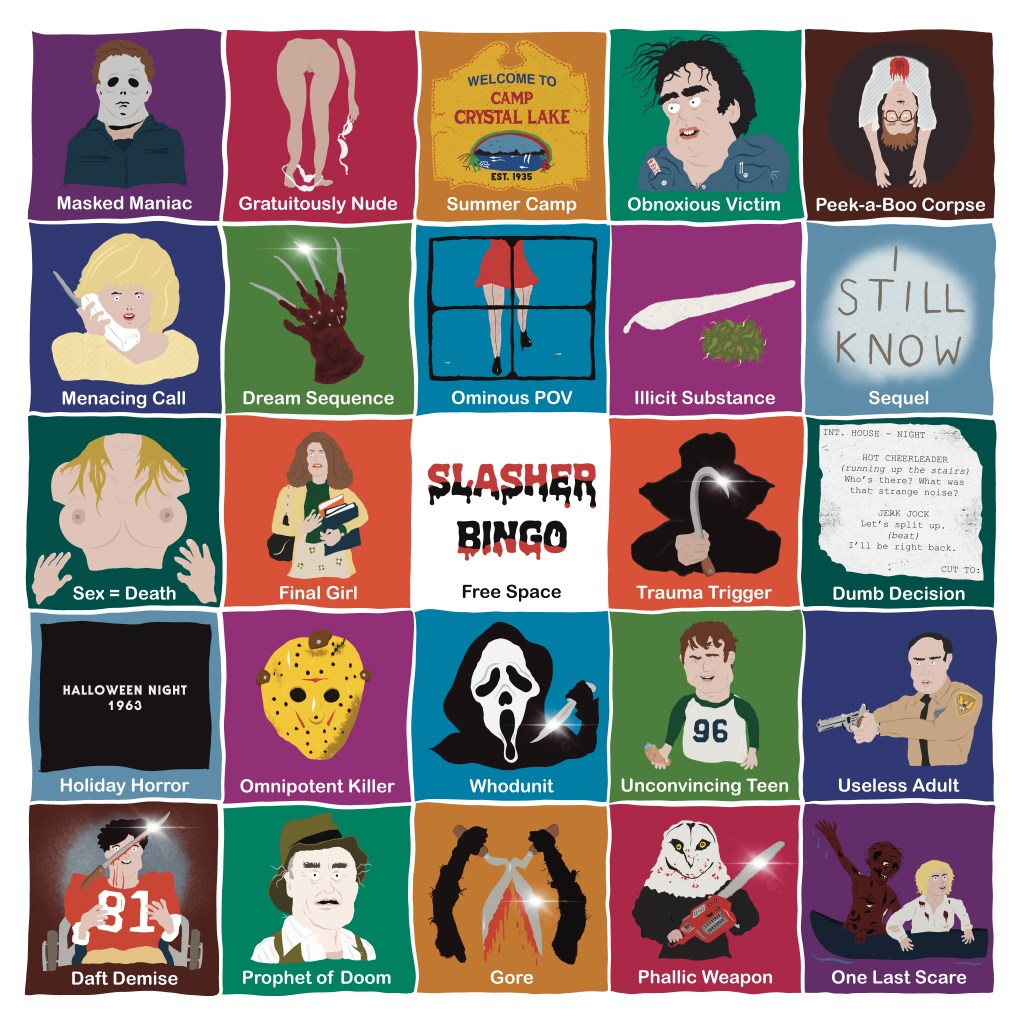
Feel free to play Binge-Bingo™ or just watchalong with a Trope-Tote™ using the Scarious Artists Slasher Bingo board below.
“Well, I’m Mrs Voorhees—an old friend of the Christie’s.”
Mrs Voorhees, Friday the 13th Part 2
I was a little self-conscious of how daft my picks were this year, but it’s all relative isn’t it? Is it dumb to make a cash grab profit of $60-70 million in ’80s bucks on your silly slasher venture? Is it wacky to attempt to emulate a sure fire horror game changer like Halloween or Friday the 13th? To invest time, bunse, and creativity in a subgenre that’s clearly on trend with the kids, and is a guaranteed money spinner? I would posit the only dummies here are the birdbrained audiences—myself included, who eat this stuff up. Perhaps I’m even dopier to continue gorging aged 44—nigh on 50 years after the fact, but here we are.
As discussed on our Pieces and Hello Mary Lou: Prom Night II, Halfway to HalloRe’ewind episode, the stiff and square, sweater-vested carper, Gene Siskel, loathed ’em all, and in a predictable dick move even spoiled the ending of the first Friday the 13th, published the mailing address of the head of Paramount Pictures—which would’ve been either Barry Diller or future Bruckheimer buddy, and coke-mad, black Levi’s jeans guy Don Simpson, and Mrs Voorhees herself, Betsy Palmer’s residential location, and encouraged his audience to mail mean things to them. Sisk also famously labelled Friday creator, Sean S. Cunningham, “…one of the most despicable creatures ever to infest the movie business.”
“I asked for lubricated rubbers. These aren’t lubricated rubbers, you understand that?”
Glazer, The Burning
Critics argued the entire slasher subgenre was the patriarchy putting modern women back in their place as second-wave feminism entered its final phase in the 1980s, and was a backhanded Sean Connery slap down reaction to the liberated, autonomous modern American woman. Yet the true slasher believers—feminists included, cited the final girl trope and the undeniable popularity of these pictures amongst forward thinking females as evidence they were empowering after all. I’d say they should each to be judged on individual merit, but as per, I tend to lean as far away from the charlatan critic, Gene Siskel, as humanly possible into more lenient, less reactionary territory—if only due to the fact that I personally enjoy the vast majority of them. It often takes getting past their typically period prologues to fully embrace a slasher. To explain, I must’ve got stuck on their shoddy exteriors, and switched off both The Prowler and The Mutilator a handful of times before fully committing to an entire watch.
Lurking around the same year is Don’t Go in the Woods—a movie some have called the worst slasher of all time. On the other hand, 1981’s perhaps fifth fellow killer camper picture, the grubby and grimy—but also imposing, Just Before Dawn, diverges decently from the strictly summer counselor pack just enough to nudge the viewing into a more uncomfortable and poignant experience—not immensely so, but certainly more than the three, more formulaic comfort picks I’ve chosen for a Hallowe’en evening in by the (camp) fire. It’s more about hikers as opposed to camp counselors, and is frankly a bit too effective, and affecting to slot in perfectly here due to a vicious women’s liberationist finale to rival Germaine Greer’s entire DVD collection. Don’t panic, it also boasts George Kennedy—Police Captain, Ed, from The Naked Gun in a prominent role. Then there’s the peculiar, nonsensical ending of 1982’s Pieces—in which a fella is relieved of his denim-covered genitalia by what can only be presumed to be the rancorous grasp of a reanimated jigsaw woman. It’s either a cogent suffragist statement—shrewdly undoing the barrage of male gaze perversity preceding it, or an asinine jump scare.
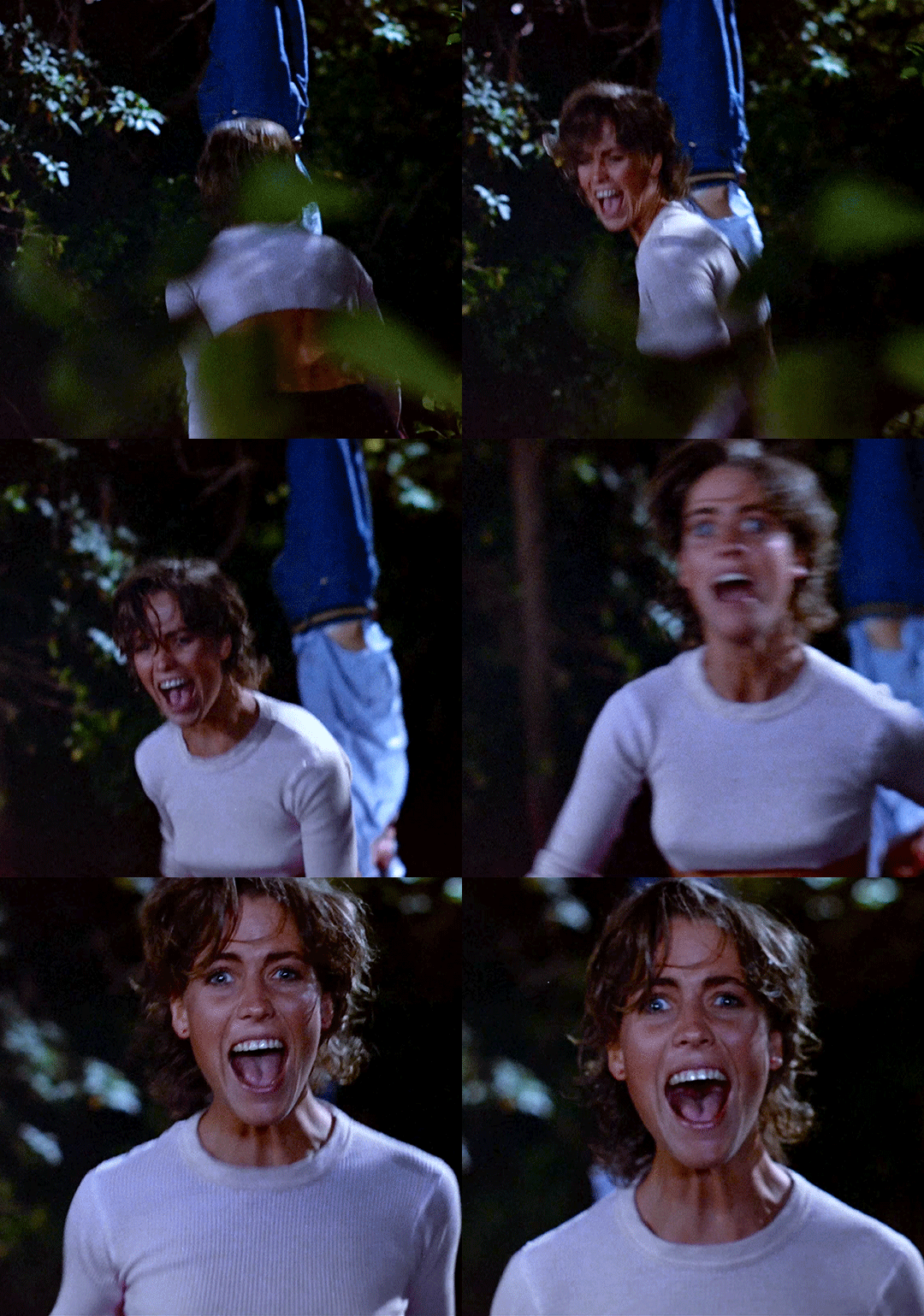
“Terry, you turkey.”
Vickie, Friday the 13th Part 2
We often yak on about sensory experiences when it comes to our HalloRe’ewind marathon—or Fun Size Snickers recipes, which are effectively three or four course meals with complimentary flavours. We’ve shouted out Whitby joke shops, witches’ rubber fingers, the indelible scent of cheapo laggy band masks, irritating plastic vampire fang gumshields, bobbing for apples in a bowl someone likely gozzed in, and the nostalgic, evocative, roasted interior aroma of ickle turnip lanterns as references for our sensorial selections. This year, the inspiration was no exception.
My parents were both teachers, and have since retired. My dad was the headteacher of a charming, cottagey primary—elementary, or grade school for our American friends, and was instrumental in facilitating outdoorsy trips with hiking boots that hurt your feet, panic-inducing Descent-style caving excursions, rainy-mapped orienteering, playing instruments and having singsongs, storytelling by a roaring fire, bunk-bedded sleeping arrangements, and scoffing tuck shop rations. So this year, I time-travelled back to my pre-teen primary, and spotty secondary school trips to Danby Fryup and Marrick Priory respectively, which were arguably the UK equivalents to American youth camps.

“Imagine doing it with Glazer. The weight of all those muscles on you.”
Marnie, The Burning
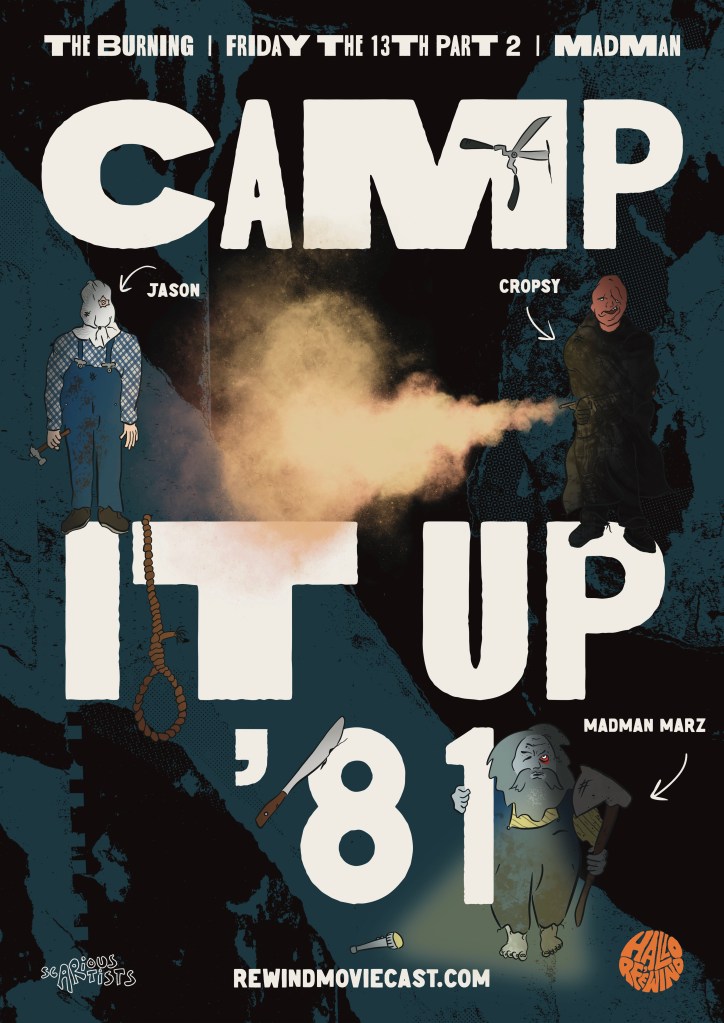
In honour of these school trippin’ days gone by, I will be indirectly—via the medium of the motion picture, spinning a trio of outdoor slashers starring marred and scarred crackpots set on sex-terror revenge with Camp It Up ’81. So make sure your firewood is dry, pack a compass—or mebbees just yer iPhone, and bear, or bear (rawr), or BARE witness to to a triptych of back-to-back, counselor cuttin’ campfire tales of mythic, murderous maniacs!
Camp It Up ’81 🏕️
8pm
The Burning (1981) 91m
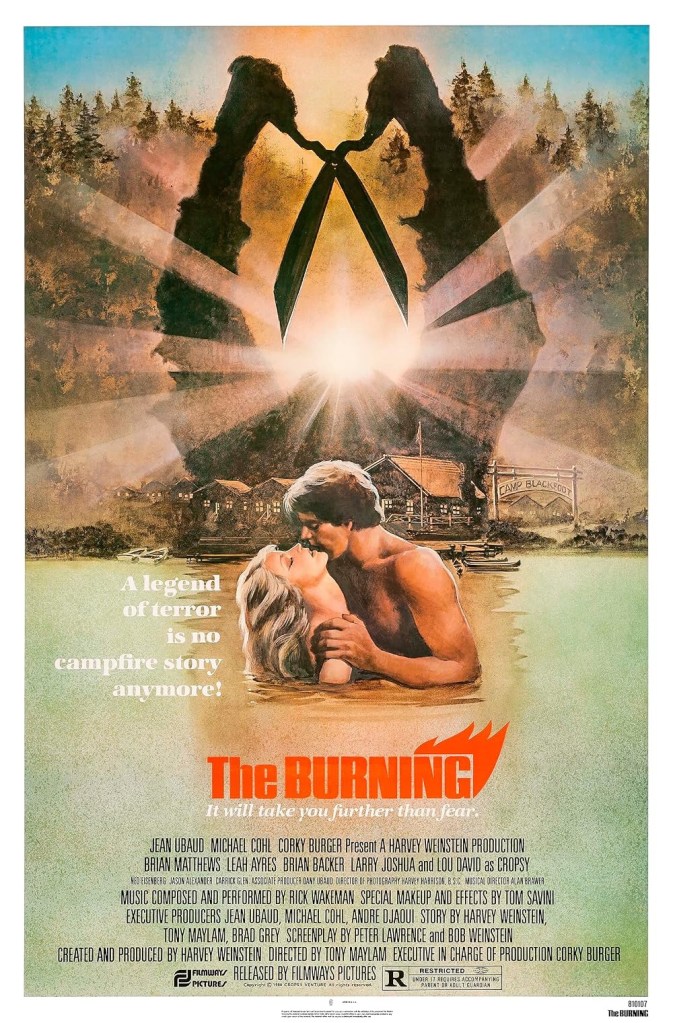
“Tonight’s the night. Cropsy’s gonna get what he deserves.”
Paul, The Burning
In the ludicrously lucrative wake of John Carpenter’s Halloween—the Cadillac of slashers, as Bruce Campbell puts it, which was released by Compass International to bank-busting business, and hastily chased up by Sean S. Cunningham’s pioneering 1980 indie megasmash, Friday the 13th, which was shrewdly snatched-up by Paramount, the majors found their shelves bare in terms of competitive pictures, and so began a free for all feeding frenzy, and the accompanying bidding wars for just about any trope-ticking finished negatives going with teens in peril, a masked antagonist, and no pricey, attached movie stars required. Cue a shitload of slasher samesies, and due to Cunningham’s summer camp-set, sub-subgenre trope codifier, the onslaught of counselor carnage copycats continued.
Notable things of which there are three: The Three Little Pigs, Three Blind Mice… Three Amigos. My three HalloRe’ewind picks this year are bookended by Cropsey maniac-inspired horror tales, so let’s begin with an impromptu visit to the burn unit—aided by a very unprofessional porter, as we take a gander at a freak in 1981’s The Burning. Perhaps you’ve seen the 2009 true-crime doc, Cropsey, or caught wind of New York’s foremost boogeyman and spiralling urban legend, in which a disfigured or wronged local man—be he an ex-janitor, funny farm fugitive, or bereaved dad—stalks the woods surrounding sleepaway camps, seeking vicious revenge against his perpetrators or any slasher substitutes who may stand in his vengeful path with an axe, or maybe man door hand hook car door. These real-life, opportunistic counselors, of course, shrewdly utilised the Cropsey myth to bond their groups, warn wayward ankle-biters against unwise solo excursions, and to lay down the law in terms of following their camp guidelines.
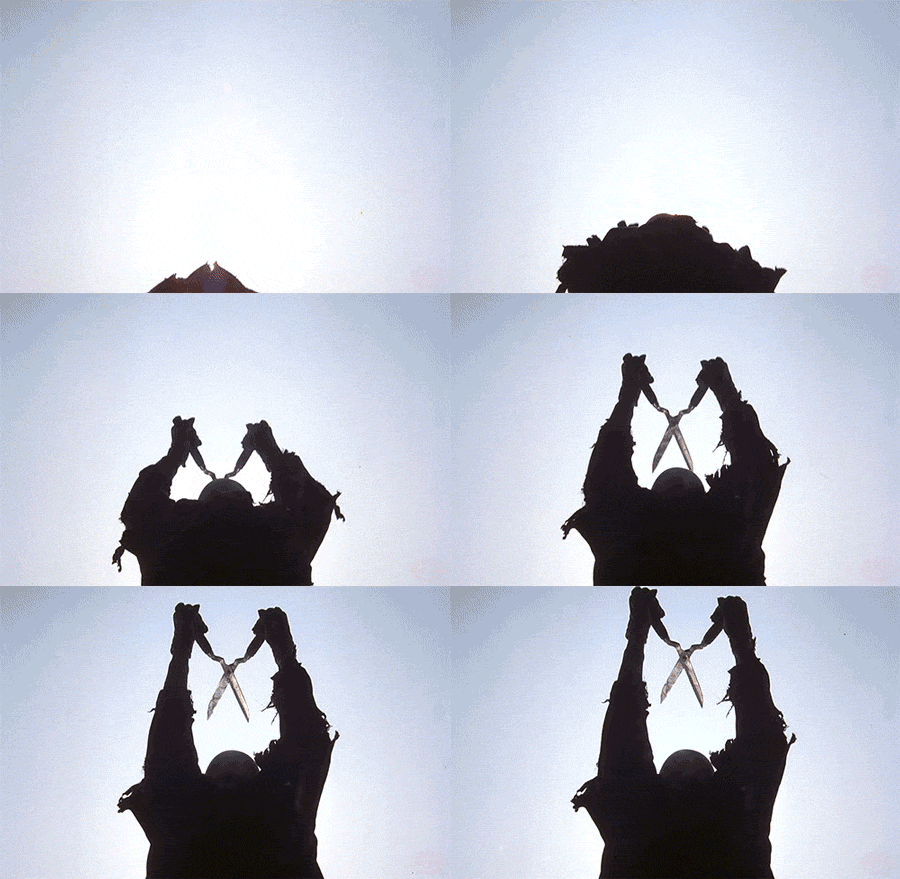
“We’re sorry, the skin grafts just didn’t take.”
Doctor, The Burning
We’re leaving for a three-day canoe trip to Devil’s Creek, so our first “Cropsy venture” takes us to Camp Blackfoot with the inaugural Miramax film—Corky Burger (nice name… not) presents The Burning—aka Cropsy (without the “e”), aka Carnage, which was created and produced by the debauched, porcine, towel-dropping, massage-obsessed, cooking pot (and Hollywood actress) defiler, and all-round dressing gown grotesque, Harvey Weinstein. I try to absolve myself of any responsibility when it comes to these lascivious pigs, and the way they conduct their sleazy selves behind the scenes of movies we happen to enjoy. Unfortunately, the direct creative Weinstein association means nobody’s really pushing this picture anymore, but think yourselves lucky I didn’t pick 1984’s Sleepaway Camp—a similar slasher with a hot potato reveal so problematic, even De Palma would put on his very white shoes, and book.
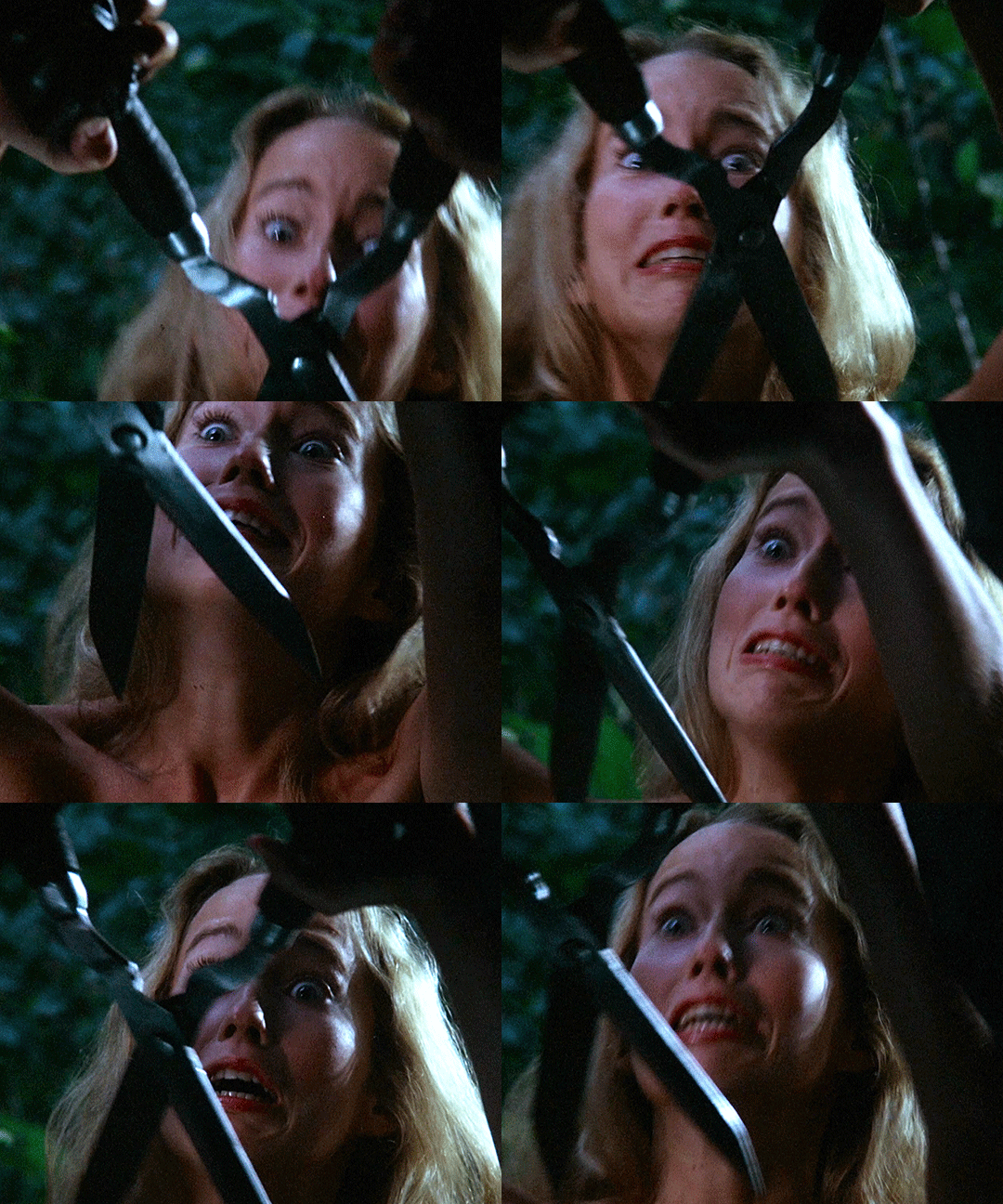
As if that creepy context wasn’t enough, The Burning sets out its sordid stall with a particularly nasty, Peeping Tom-esque, prostitute stabbing with a geet big pair of scissors, which seems to trigger former camp caretaker, Cropsy’s preference for pruning juveniles with gardening shears—he loyally persists with this edged weapon of choice throughout, alongside a rinky-dink, crudely-fashioned flamethrower.
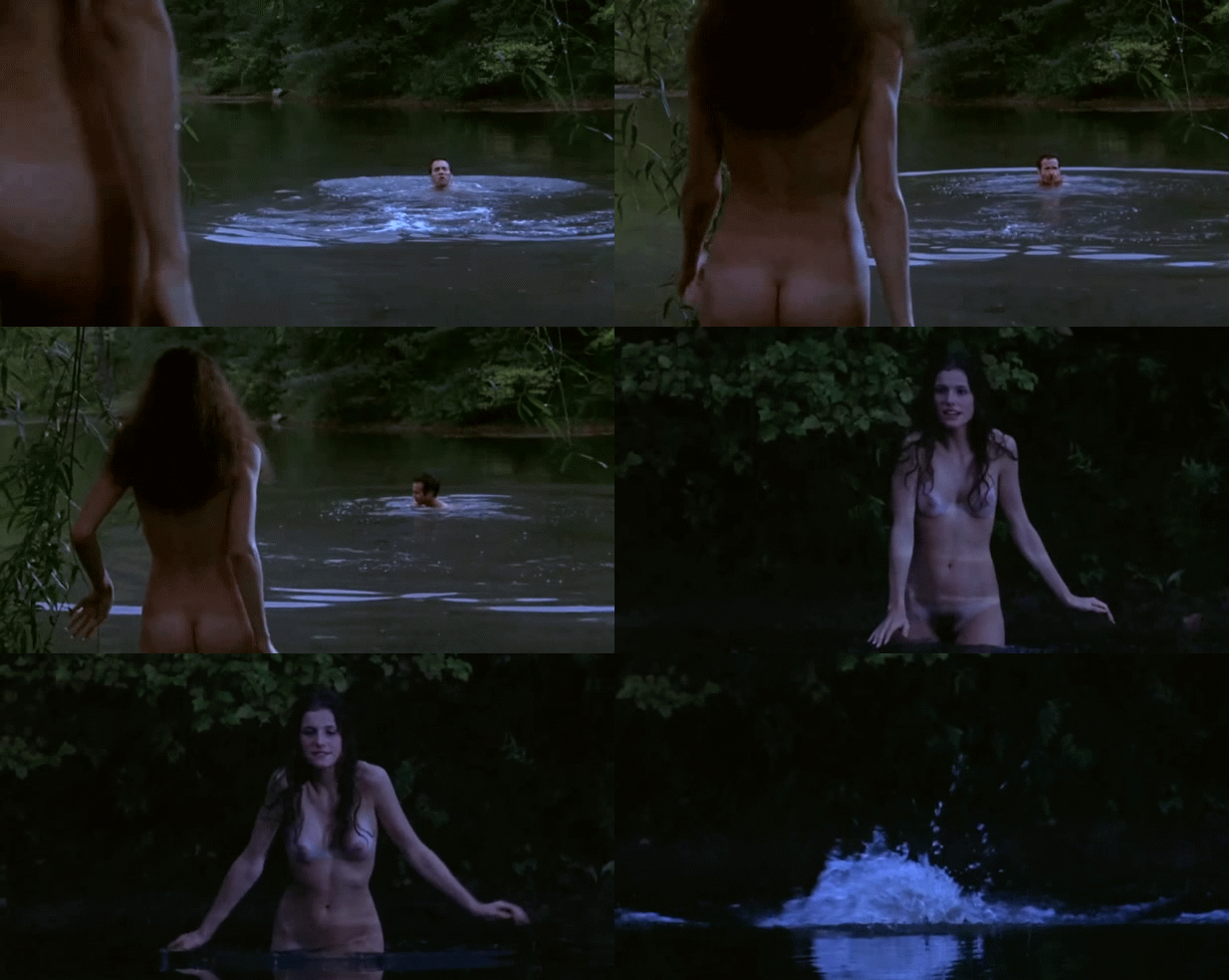
“The world bantamweight jerk-off champ over there.”
Dave, The Burning
Shady and skeevy? You bet. Some of the disreputable dialogue in The Burning actively oozes, as if Harvey “plant pot perv” Weinstein copied it directly from his bumper book of male chauvinist chat-up lines, and pasted ’em into the script—particularly Eddie’s more desperate, nastier sexual advances. Not to mention elderly teenager, Jason Alexander, refers to a girl’s derrière as “prime meat,” whilst still somehow looking forty years old—even with all his own hair. The Burning is also curious in the sense that it has no final girl to speak of, and perhaps that’s why it palpably veers into a meaner lane of misogyny. There isn’t even a loose argument for a feminist slasher statement here. The ladies are all either starkly starkers (see Sally’s drawn-out, soapy shower scene, and Karen’s superfluous skinny-dip) and explicitly slaughtered, or simply have no real relevance to the plot.
There are several naked glutei maximi—unforgivably, one belongs to the definitely not-Indian guy from Short Circuit 2, who directed the Beckham doc, and another is George Costanza’s. The aforementioned Fisher Stevens plays a character called Woodstock, and participates in what is surely the hairiest, most hideously revealing mooning scene I’ve ever had the misfortune to witness. Truly grim.
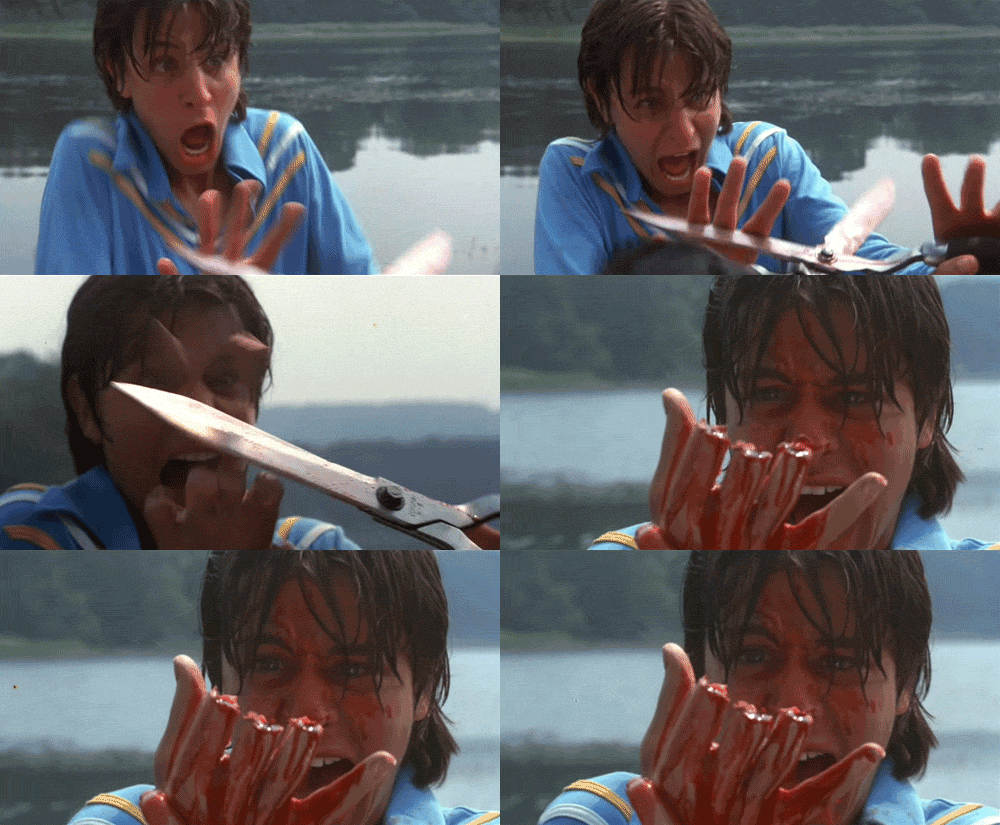
“Man, this guy’s burned so bad—he’s cooked. A fuckin’ Big Mac. Overdone. You know what I mean?”
Hospital Porter, The Burning
As an interesting wrinkle for Italian horror fanatics, the necessity to mask Cropsy’s distorting burns means he doubles as somewhat of a giallo killer in appearance—signature fedora, leather gloves, and black jacket. Disappointingly, to a degree, in spite of clocking in quickly at a mere 91 minutes, The Burning still drags here and there, and is certainly clunkily-directed at intervals—perhaps partly due to the fact that From Dusk Till Dawn Sex Machine, Tom Savini “designed” the horror sequences. Typically, the director will work with an effects technician to achieve the magic trick photography of these splattery killin’s, but here Tom was evidently trying his hardest on his lonesome.
The Burning is available now on 4K Ultra HD + Blu-ray.
10pm
Friday the 13th Part 2 (1981) 87m
“Toke?”
Vickie, Friday the 13th Part 2
Slip on your copper-coloured, shiny silk panties, spritz your bits, and bend over in a car to look for a hairbrush now, as we drive a clapped-out heap to Camp Blood for—you guessed it, 1981’s summer camp slasher sequel, Friday the 13th Part 2.
Known perhaps most notably for the pre-hockey-masked, The Town That Dreaded Sundown-homaging, burlap sack hooded Jason, and the calamitous yet hilarious (not to Roger Ebert) wheelchair machete murder, and its inexplicable, incendiary exploding title credit, Part 2 is the gory glue that holds my Camp It Up ’81 trilogy together. It includes an all-encompassing prologue flashback to the tale of Mrs Voorhees and her disabled son, which underpins the entire Friday franchise, and reminds audiences of the original’s key events. Namely, American telly regular on the CBS game show, I’ve Got a Secret, Betsy Palmer, as Mama Voorhees—chewing up the scenery with her giant dentures in a periwinkle blue Cosby sweater, and properly smashing Adrienne King’s face into the sand like it’s an exposed top turnbuckle. They then not only “recap the decap,” but also replay the iconic Jason popping out of the water shocker. It’s smart in the sense that we’re duped; prepped for the continuing journey of the original’s lead character, Alice, but they whack her at the beginning because in a slasher such as this, a through-line protagonist is quite unnecessary. It ain’t Janet Lee in Psycho, but definitely has forerunner to Drew Barrymore in Scream vibes.
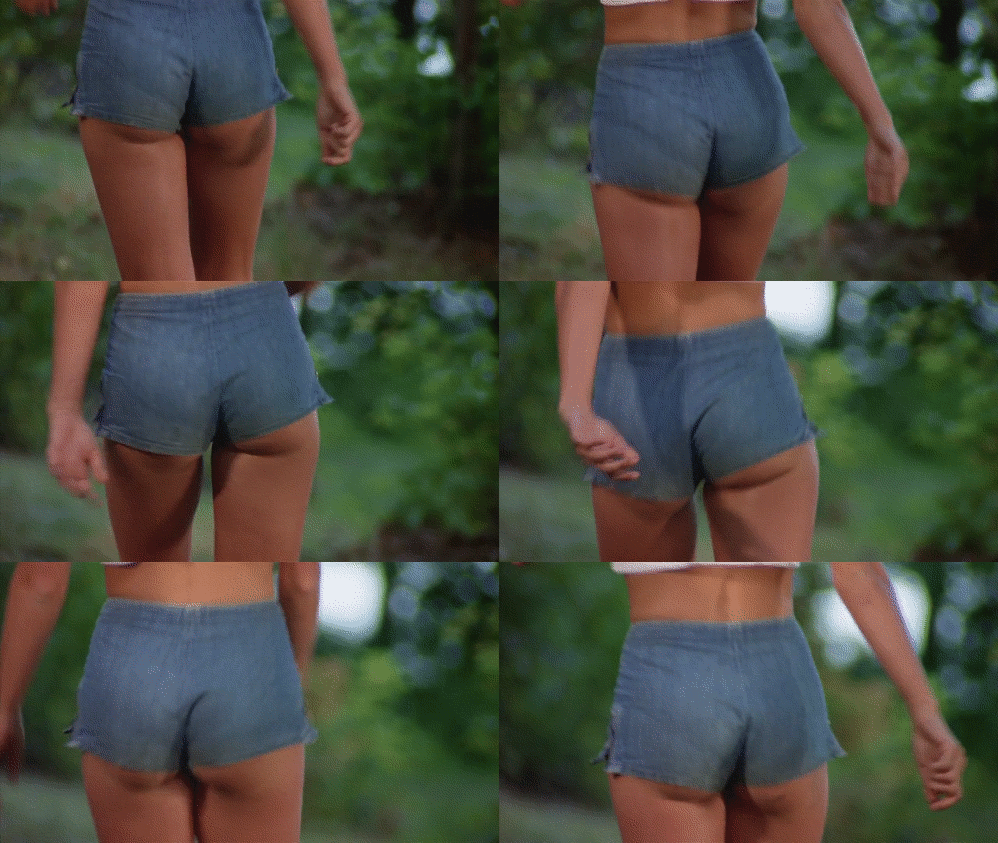
“I ought to let you hang, you pervert!”
Terry, Friday the 13th Part 2
Of course Jason isn’t a hulking, supernatural, toxic waste-dipped mutant freak at this stage—he’s a maybe 5’8″ short king, dressed like a farmer in overalls with a bag on his head, falling over awkwardly, and instead of just murdering someone instantly, he seemingly must wrestle with them for ages on the ground. He is certainly fallible. If you wait in a bush for Jason to round the corner, you can quite easily kick him in the bollocks and buy yourself some getaway time.
It’s got some sluggish, laborious chases—particularly the one involving the ranger chap. It’s too long, and not tightly-wound enough. There’s a ginger character in ridiculously short shorts, who looks like he’s going on safari with a tablecloth for a shirt. It’s got girls in bikini tops, a humorous cut from a Shih Tzu to a hot dog on a barbecue—there’s even an abandoned Halloween mask folks periodically pick up and put on.
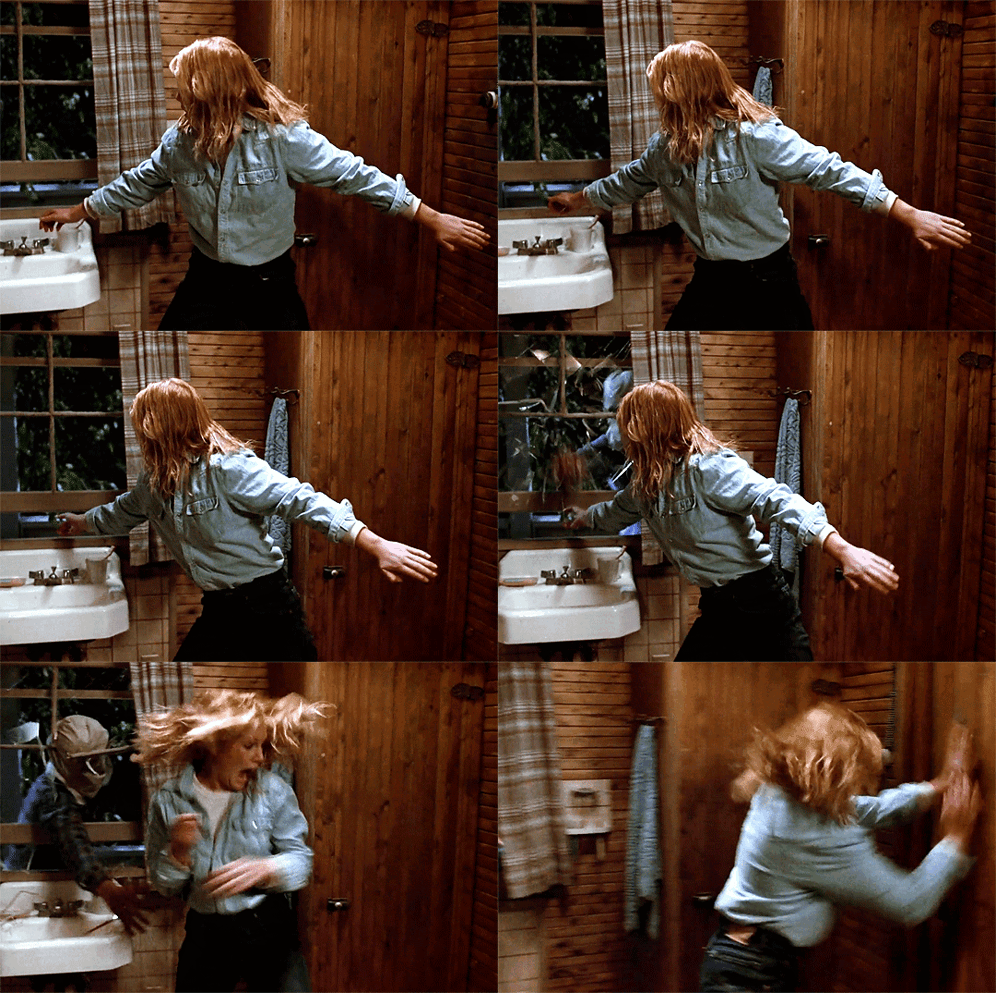
“I don’t want to scare anyone, but I’m going to give it to you straight about Jason. His body was never recovered from the lake after he drowned. Five years… five long years he’s been dormant… and he’s hungry.”
Paul, Friday the 13th Part 2
Thankfully, amidst these carefree teen fools, there’s Ginny Field—a perceptive and tenacious final girl, played adeptly by Amy Steel. Alright, Part 2’s child psychology ending doesn’t entirely play, but it—I hesitate to say, cleverly homages Hitchcock’s Psycho with Ginny cosplaying as Jason‘s mommy by donning one of horror’s most iconic jumpers—next to Freddy’s. Although strangely, Jason is an unlikely main character to be here, as it is he who fans ultimately rooted for as the series continued. They would also regard the revolving door of teenage guest stars as mere fodder—eagerly awaiting the next effects set piece dispatch. Much to the bemusement of America’s dorkiest pundit duo, Sisk and Eebs, Friday nuts craved satisfying slayings as payoffs—even ranking the likes of The New Blood’s sleeping bag tree trunk bashing, and my fave entry, Manhattan’s rooftop boxer decapitation punch, as if they were a Goal of the Season montage on Match of the Day. What sort of warped, infantile mind would do such a thing?
The best kills in Part 2 include a claw end of a hammer to a sheriff’s bonce, a pre-Basic Instinct ice pick temple (and nose if you’ve seen the full, deleted effect) stabbing. Gene and Rog may not have got it, but poor paraplegic hunk, number 81, getting absolutely annihilated with a machete to the brow, lifelessly rolling backwards in his wheelchair, and awkwardly clattering down a substantial flight of rickety death stairs before bafflingly bleaching out to white is perhaps the maddest murder of the bunch.
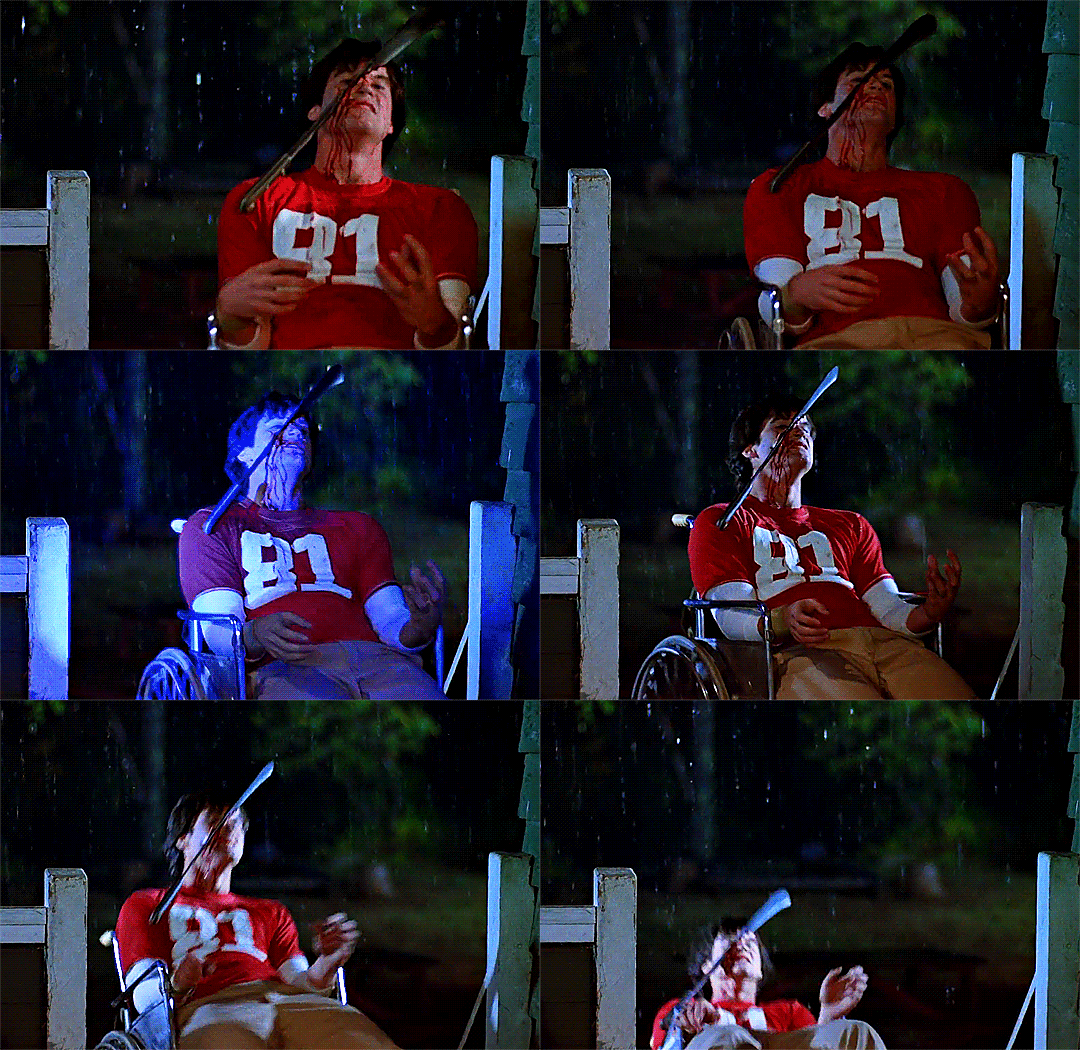
“I’ll be right back.”
Vickie, Friday the 13th Part 2
To this day, there’s an infuriating censorship quagmire when it comes to the entire Friday the 13th series. Conspiracy theorists submit Paramount are actively ashamed of it, and refuse to reinstate the missing footage to give what Ebert called this “unpleasant, absolutely reprehensible, little sleaze pit of a movie,” or any of its slippery, deformed siblings uncut releases. This proper annoying wrinkle applies to almost every film in the franchise, which even on the latest 4K editions, have trimmed and truncated deaths. Some of the missing bits—The Final Chapter, for example, appear pristine and easily restorable, and others—namely Part 2 aren’t, due to their only remaining origin being an effects guy’s serendipitous, yet shabby VHS tape. Frustratingly, forty-eight seconds of celluloid is still undiscovered in a cutting room bin somewhere, or has since become guitar picks.
Friday the 13th Part 2 was released through Scream Factory on Blu-ray, but as with the rest of the slashed-canvas slashers in this set, the expunged butchery and bloodshed couldn’t be reintegrated into the movie due to either complete incompetence, sheer laziness, or an unattainable source print or negative. The Friday kills were always intended to be protracted, and in most cases were paced much better, with a more shocking nature—particularly Scott hanging upside down and getting his throat sliced in Part 2, which goes on forever and ever, and the graphic, ice pick driven through Alice’s schnoz at the outset, when the fourth-wall-breaking King discovers Pamela’s noggin in her freaky Frigidaire.
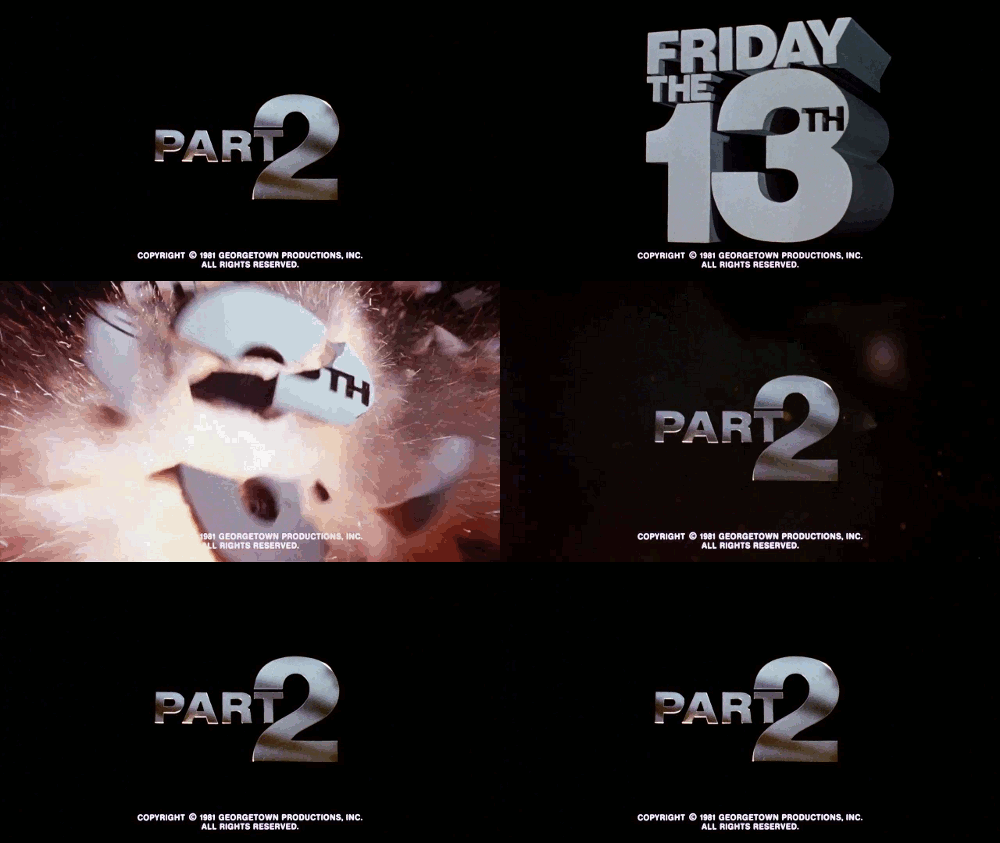
“These kids smoke better dope than I do.”
Paul, Friday the 13th Part 2
Sparing these scissor-happy splices, these now iconic films may have had a shot of standing alongside ’80s splatter staples, The Prowler, The Mutilator, Maniac, Intruder, and My Bloody Valentine, if someone could only get their act together, locate, and reassemble the missing sequences in the same manner. No one wants to watch a dulled version of a movie like this, but sadly, to this day—outside of fan edits, we have little choice. The best you can hope for is to pop over to YouTube afterwards, where some kind crank has recut the kills so they continue on seamlessly, albeit in their lower quality work prints—much like ’81’s My Bloody Valentine did in official releases until it was recently restored for the 4K. Fingers crossed we get uncensored cuts of all the Fridays at some juncture, but all signs point to highly unlikely. If they could’ve, they probably would’ve already.
Friday the 13th Part 2 is available now on 4K Ultra HD.
Midnight
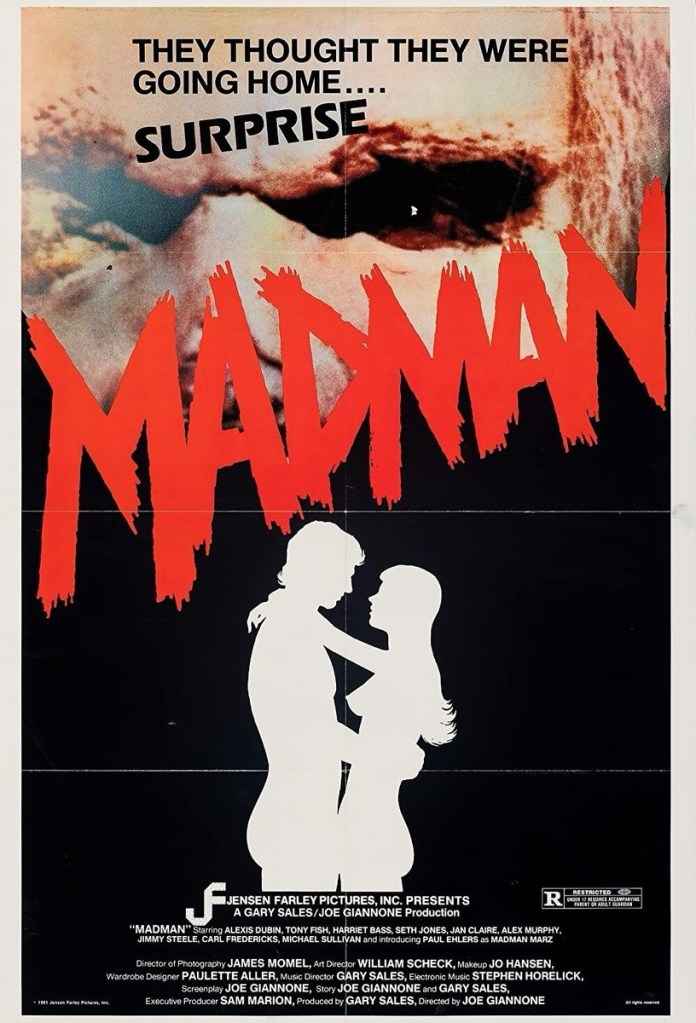
Madman (1981) 88m
“His name is Marz—Madman Marz.”
Guy, Madman
All Hallows’ Eve. It’s midnight. North Sea cottages is our third and final woodland destination as we unwisely summon Madman Marz—a hirsute, backwoods local yokel, and Bigfoot-kinda-looking bloke, for a chilly, generic slasher to warm the cockles of your heart. We are quite literally at the whim of a madman for 1981’s… Madman.
We open on a familiar campfire setting with a geezer that simultaneously resembles Jimmy Fallon, Count Karnstein from the Hammer trilogy, and the lead singer from The War on Drugs, crooning a folky ode to the Madman, “Song of the Fifth Wind” in the style of Longlegs doing “Stairway to Heaven,” and relating the tale of Marz… Madman Marz—an alcoholic farmer, who was a real nasty piece of work by all accounts. According to the legend, this guy went loco down in Acapulco one night and bludgeoned his wife and children, then went to the pub, slammed his bloody axe on the bar, and drank himself a beer. Later, ten men jumped Marz, and strung him up—hanging him from a tree. They axed him in the skull, and left him dangling from a noose, but the following day the body had vanished, as had the corpses of his whole family, and they were never found, or seen again.
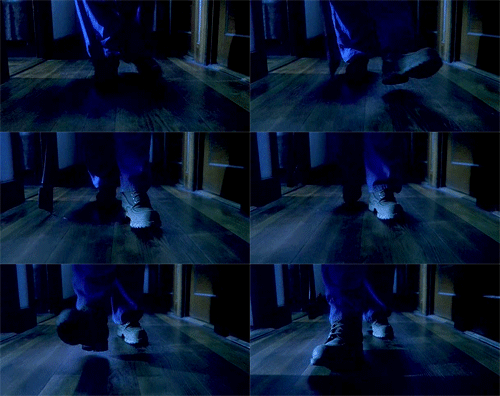
“Play the game with a fair heart and you’ll always be able to look at yourself in the mirror. Play too hard to win and you might not like what you become.”
Max, Madman
The object of cocky senior camp counselor, T.P. (Tony Fish) aka Jimmy Fallon’s ceaseless affections is none other than the lead actress from George A. Romero’s Dawn of the Dead, Gaylen Ross as Betsy—credited here as Alexis Dubin, presumably to spare any acting résumé blushes. There’s also a dude with a tash that looks like that one off of Hall & Oates because… 1981. He looks like he just stepped off the cover of Private Eyes.
Speaking of a special retreat for gifted children, the youngest kids I teach in Korea are five years old. I currently have two kindergarten classes, and if you asked them to be a monster they would be the Madman—that’s how glaringly broad this portrayal of an abominable, mountain man barbarian is. Don’t get me wrong, I’m a huge fan. I’ve got all his records. He’s a brute; beastlike and savage, he growls unforgettably, he’s got long fingernails with a Count Orlok arch to his clawed, feral hands. Nevertheless, it’s a real performance and a truly underrated slasher villain portrayal. There’s a kinda scratchy cackle that appears on the soundtrack whenever the titular Madman is near, and when we do bear witness—be he up a tree in silhouette, flashing up momentarily in a torch’s glare in the woods, or partially veiled by a car bonnet, the soundtrack blares the same three, easily mimicable notes. How many movie monsters have their own theme tune? The Madman does—simply titled, the “Song of Madman Mars.”
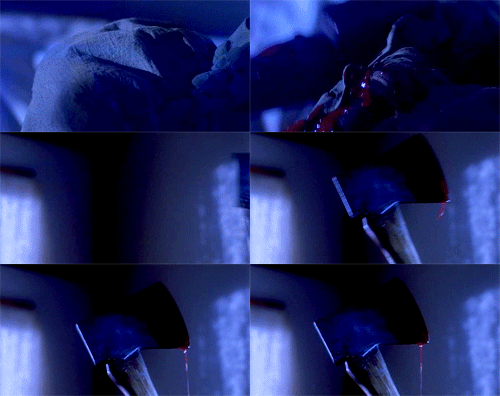
“Bee-boo, bee-boo, bee-boo.”
Betsy, Madman
The Madman is surprisingly spritely. He’s a tad theatrical and has boundless energy, which he uses to hasten purposefully across the screen, and if there’s one thing the Madman enjoys as much as doing murders, it’s dragging dead folks back to his dusty ol’ farmhouse. He’ll gladly push you into a piano, and scratch your face right down to the bone. He’ll haul you through an old house by your hair and impale you on a spike, Leatherface—or Mutilator-style. Remember when Ultimate Warrior would lift other wrestlers above his head and do several straight-armed reps with ’em before administering a gorilla press slam? Hulk Hogan would do the gesture, but he could never stretch his 24-inch pythons up all the way. Well, the Madman can do that. In fact, not only can he lift you up right above his head, he can also break all your bones at the same time.
He’s equally at home in a dusty cellar, putting out candles with his hands as he is climbing an enormous tree like a gibbon. He likes to chop you up, or hang you from a tree—that’s his killing style. Psychologically, the gotcha moments are unpredictable because the Madman can plant his axe firmly in your cranium out of nowhere, or unexpectedly noose you from above, hike you up high from a nearby branch, and dangle you by the neck until ye be dead. The Madman, bless him, also can’t speak English—he growls, grunts, and makes odd, animalistic mutterings and indecipherable bestial utterances. He gallops around the gaff giddily—clearly completely out of his mind, but with a purpose. The Madman also admirably accomplishes all of his goals without any shoes on, which I thought was remarkable and deserved some brownie points. Also, quite contrarily, the Madman will watch you do the hunka chunka in a hot tub—he’s not averse to that. The Madman is a heavy breather, and we often see from his point of view. He’s omnipotent. The screenplay even states outright, “He can be anywhere at any time, and if he hears you call his name, he’ll come for you, and if he comes for you, he’ll get you.”
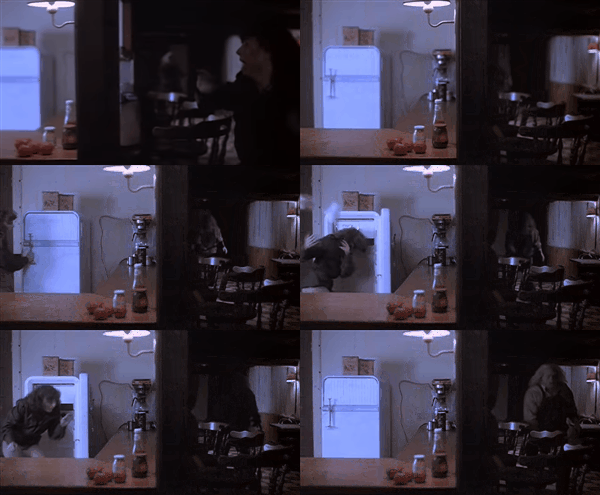
“Hold it, I’m getting a bit too old for this kind of talk. I’m leaving.”
Max, Madman
Again, the inept, clumsy transitions between shots are sometimes dissolves, which get my back up no end, but the plethora of pet peeves are continuous throughout all three of my picks, so it’s actually quite befitting for this curated trilogía. Not that it would ever be humanly possible, but never hide in a fridge under any circumstances. The Madman can hear you chucking objects out, and can likely see all the groceries on the kitchen floor. Horrible decision. The filmmakers have really thought this through, and Madman‘s keen misdirection is crucial as we’re never really sure when this rustic ogre will strike. When he inevitably does, it’s always a jolt, it’s always amusing, and I adore the lavish sound effects. There is an enigmatic, and palpably eerie—almost serene presence to the lurking dread of Madman, and it’s more playful than Weinstein’s ’81 Cropsy-a-like, The Burning. You know when Hitchcock used to bang on about his pictures being less like a slice of life, and more like a slice of cake? Madman is a slice of cake. Cryptically, the Madman isn’t killed on screen—he’s down in the basement of his house as it burns, with all his victims just hangin’ around. So beware. Don’t utter his name above a whisper, or perhaps do—he just might lumber back for an overdue sequel. Until then, I urge you to enter the cult of the Madman.
Madman is available now on 4K Ultra HD from Arrow.
DEVLIN’S PICKS
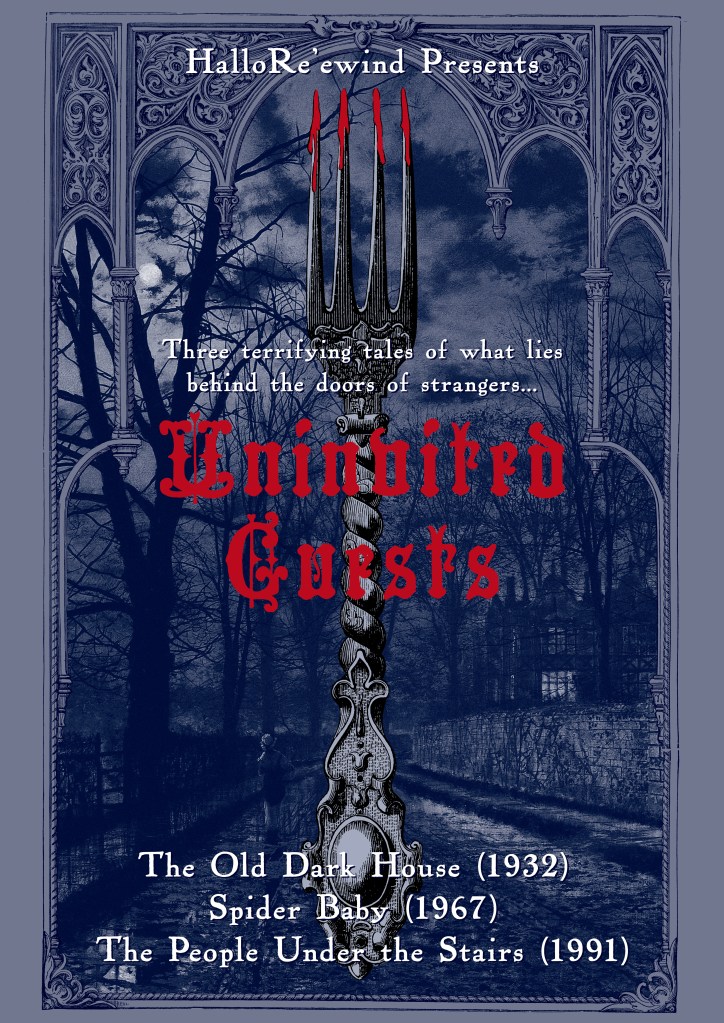
Knock, knock.
Horror can be found anywhere. In the unknown, the murky darkness of mysterious locales, where sure footing is hard to find and you don’t even know where the next corner is, let alone what is lurking there. And in the familiar, inverting the veneer of safety one can feel in your own surroundings, in the very heart and hearth of your own home, which, when riven by danger, offers no solace no matter how far you run. Because, where else can you go?
I wanted to explore the uncanny middle ground between these two poles. The queasy weirdness of existing within someone else’s particular place, surrounded by their comforts and peccadilloes and rituals and totems. The smell and groove of their chairs which mould to their forms, but jab coarsely at yours. The odd patterns of speech and rhythms which leave you groping for an entry point to conversation. The twisting and distending of everyday activities so close, yet so unfamiliar, to your familiar. If you’ve ever cracked your neighbour’s mum’s commemorative, hand-embellished decorative side plate from the 1993 Tall Ships North East of England Races and then endured a tortuous dinner of beef and onion Crispy Pancakes while you waited for your transgression to be discovered, you’ll know exactly what I’m talking about.
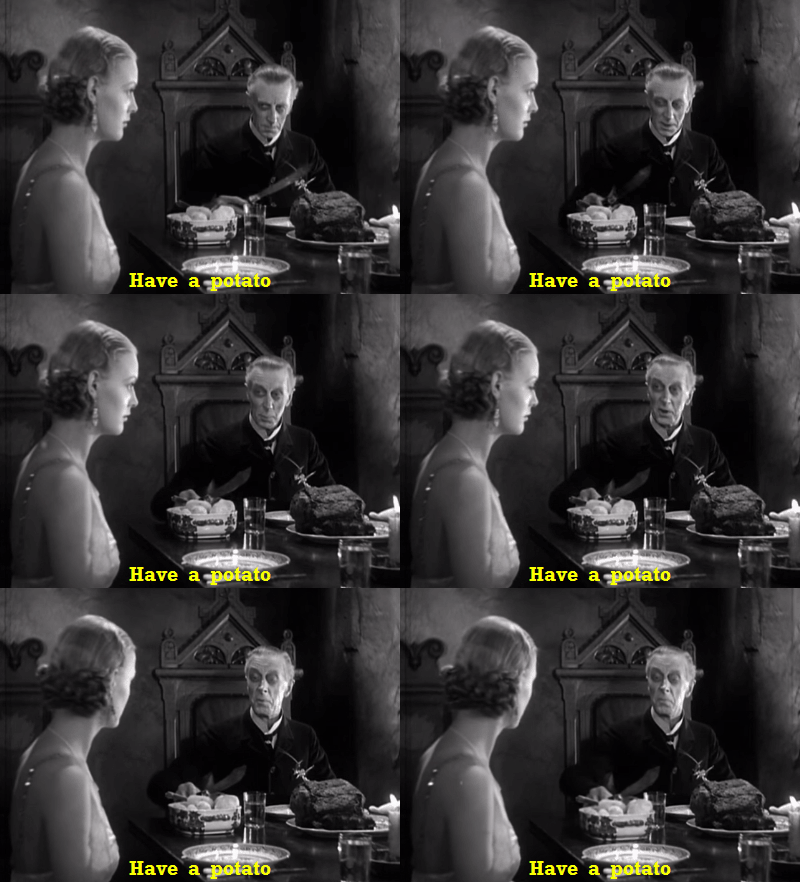
This year’s HalloRe’ewind comes crashing back to Earth after last year’s voyage through the terrifying cosmos. All the way back to the home itself – but not as occupants. As Uninvited Guests. After bending the rules over the last couple of rounds, first by focussing on the visceral disgust of Gloop! and then declaring that We Are Not Alone (We Are Fucked) in a harsh and mad universe, I’ve come back around to a more classic interpretation of how Halloween films feel to me. Storms, creaking doors, weirdos… there aren’t ghosts and spooks to be found per se, but there’s plenty of gothic atmosphere to go around in my trio of terrors. I’m also dividing my picks across 3-decade increments, chronologically, beginning all the way back in the 1930s at the height of the Universal Horror era…
Uninvited Guests 🏚️
8pm
The Old Dark House (1932) 72m
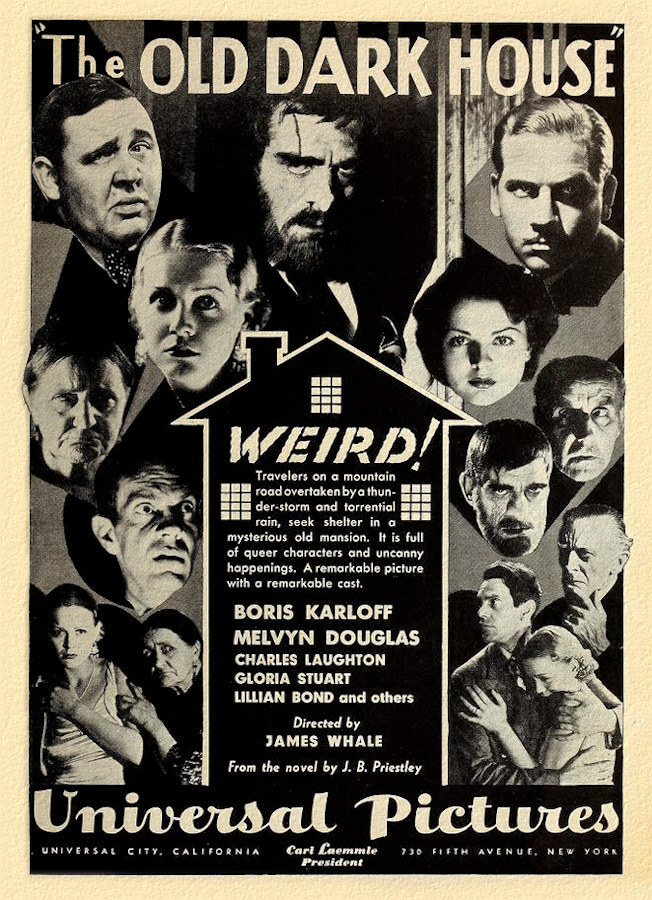
“It’s a dreadful night.”
Margaret, The Old Dark House
Director James Whale, the year after his seminal Frankenstein, adapted J.B. Priestley’s sophomore novel Benighted into this fantastic pre-Code chiller for Universal, bringing his modern Promethean creation Boris Karloff along for the ride. Unusually for a Hollywood production, West Midlands (Whale is from Dudley) meets West Yorkshire (Priestley, Manningham) in a wet and wild Welsh countryside, as sopping, miserable couple Philip and Margaret Waverton argue in the incessant rain while bringing their raffish friend Roger Penderel on an ill-fated drive to Shrewsbury, their final destination cut off by dramatic mudslides. Much to the amusement of Roger, who fears Shrewsbury may not have had much to offer that would be preferable to slopping about in the sludge.
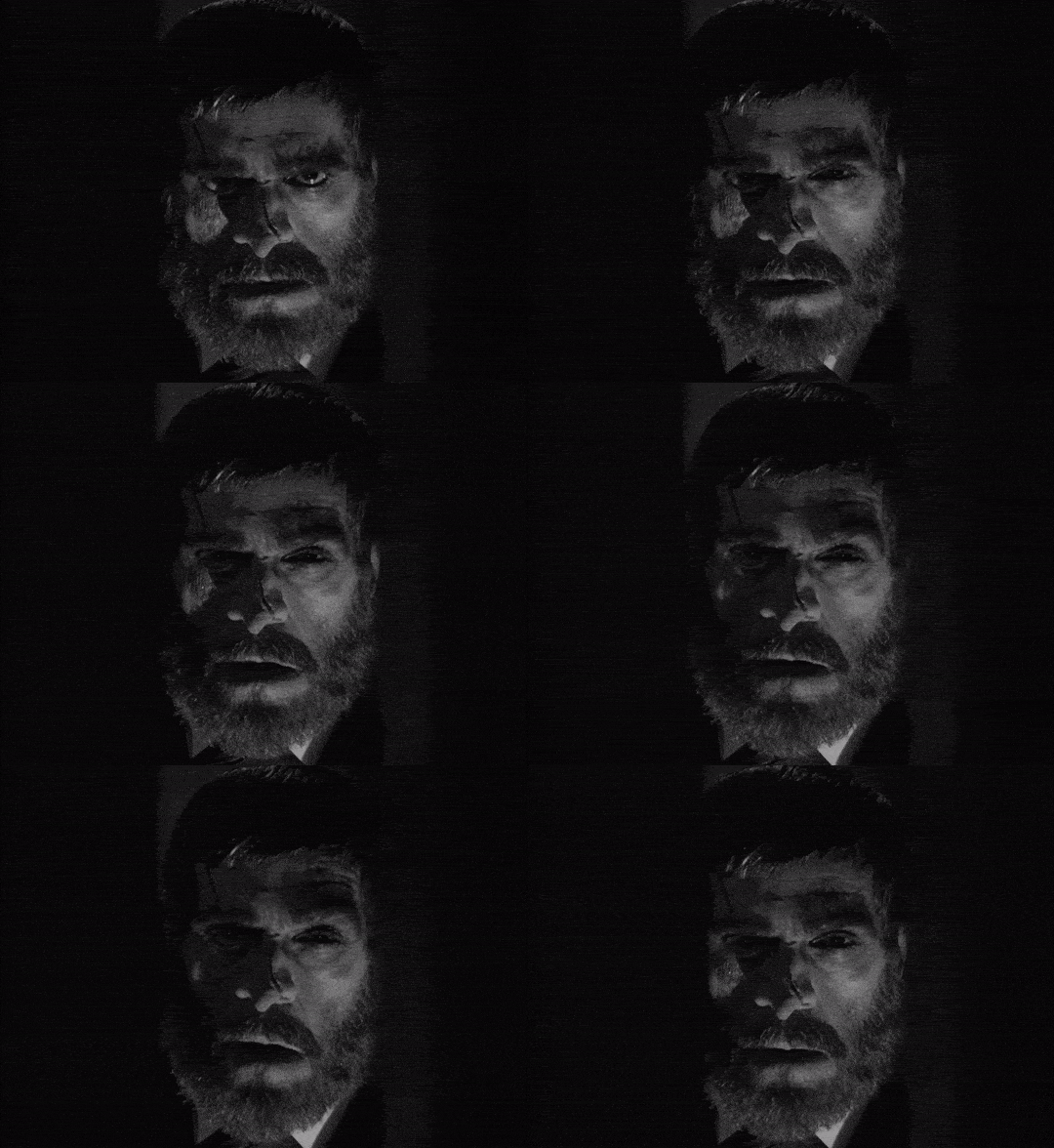
Fearing their motor may be buried in the collapsing hillsides, the group alight on a vast country house – played here by a truly adorable scale model – and knock at the gigantic, imposing door. It’s eventually answered by an odd, scarred, hulking brute in a suit, played, of course, by Karloff in a performance that emphasises heavy brow work, scowling, grunting, and standing too close to people. Reluctantly, the butler’s employers allow the soggy strangers to take refuge in their voluminous, castle-like drawing room. They are elderly siblings Horace and Rebecca Femm. He, a nervous, hand-wringing, birdlike fellow with a yen for gin who fears the building will be all but swept away; she, a pucker-faced scold, whose withering glances and barely concealed aversion to this unwelcome intrusion sets all of the travellers ill at ease. Most of all Margaret, after she accompanies Rebecca to her late sister’s old bedroom so that she can change out of her wet clothing. As Margaret slips into some risqué silk undergarments, Rebecca intones that her deceased sibling basically died of being a massive slut – and Margaret too seems enraptured by fleshly love. Her seething visage grimaces and taunts from a dozen distorting mirrors throughout, as Margaret panics at the old lady’s taunts, and, after she is left alone, she throws open the last sash window gasping for fresh air, only for the raging storm outside to drive her back out into the main room and the stifling fireside strangeness therein.
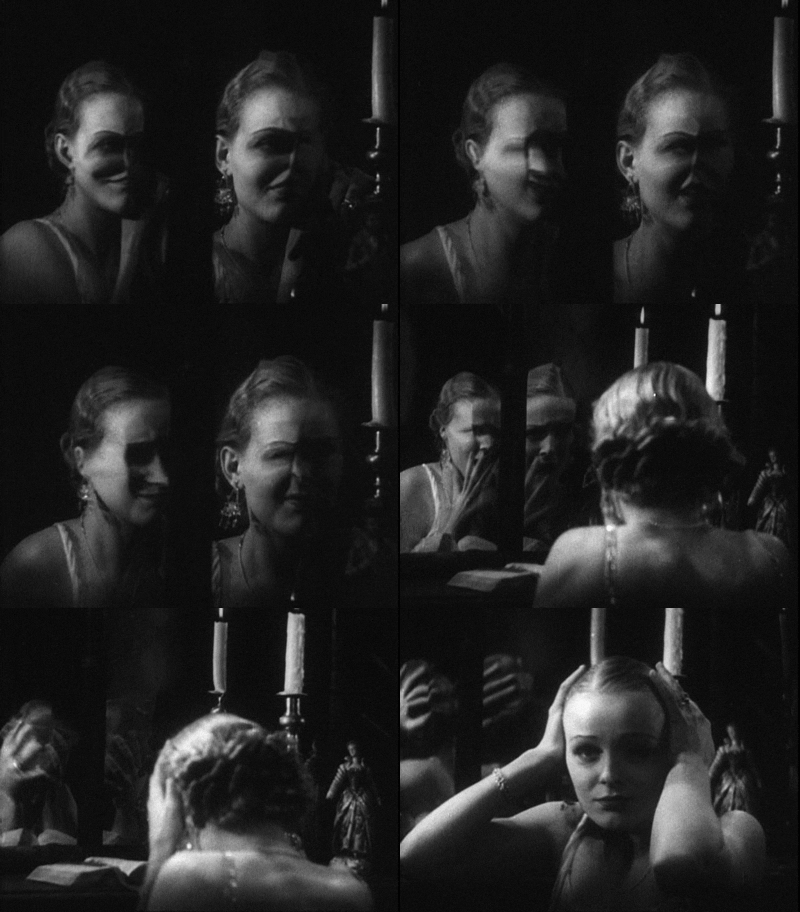
The kooky siblings tell the group that they are not alone in the house – their ailing father lives bedbound upstairs. But, does that account for all of the inhabitants? What of the strange, high-pitched giggling heard from a bolted-shut upstairs bedroom? Added to which, Morgan, the butler played by Boris Karloff, is a man prone to dissociative drunken episodes, and possessed of the huge stature to cause real damage when in that state. Over a supper of dry meat and boiled potatoes with vinegar, they also argue over Rebecca’s fervent Christianity, mocked by Horace when she interjects with grace before they can tuck in. But their spartan feast is interrupted by the arrival of two more stranded passing travellers – bullish Northern businessman Sir William Porterhouse (played by Charles Laughton), and his saucy chorus girl chère amie Gladys here to stir the pot.
As the motley assemblage exchange fireside pleasantries and barbs about their circumstances, with Porterhouse sharing the class-based tragic backstory of his pathway to riches, and explains his tenuous relationship with his mistress, while Penderel makes sly advances on her, the classic drawing room mystery set up will remind you of why, if you went to British comprehensive school in the late 1990s, you vaguely remember the name of J. B. Priestley: he wrote the classic An Inspector Calls, and his socially-conscious interlude here draws some fascinating little character beats that carry us through to a gonzo, fiery, violent final battle that features a nasty looking two-man balcony swan dive stunt that Jeff Hardy himself would be reticent to attempt.
A late gasp before the Hays Code, instituted in 1934, hampered some of the elements that make this such an odd treat, there’s a fascinating flippancy to some of the nastiness and weirdness contained herein, without the moralistic finger-wagging that was bolted on to later horror features by political necessity, which eventually saw the genre slip out of fashion. It’s not a straightforward horror, per se, so much as a gothic chamber piece with a streak of dark humour running through it. It’s oddly comforting in the way that so many films of its era are – in its clearly stagebound sets, neat, controlled lighting (including some wonderful, German Expression-nodding shadow work), and warm, mono sound, but acerbic enough to keep the interest and reward close attention, so early in the genre’s formulation that you can’t predict its next move. James Whale’s openness about his homosexuality, incredibly unusual for the era, can perhaps have a way of allowing viewers to infer subversion or queerness where one usually wouldn’t, but Ernest Thesiger’s performance as the catty, skittish, effete Horace is nuanced and magnetic and oddly tender given the circumstances. The reveal of the ailing family patriarch is also a fascinating choice for gender fuckery, in ways it would be a shame to spoil here.
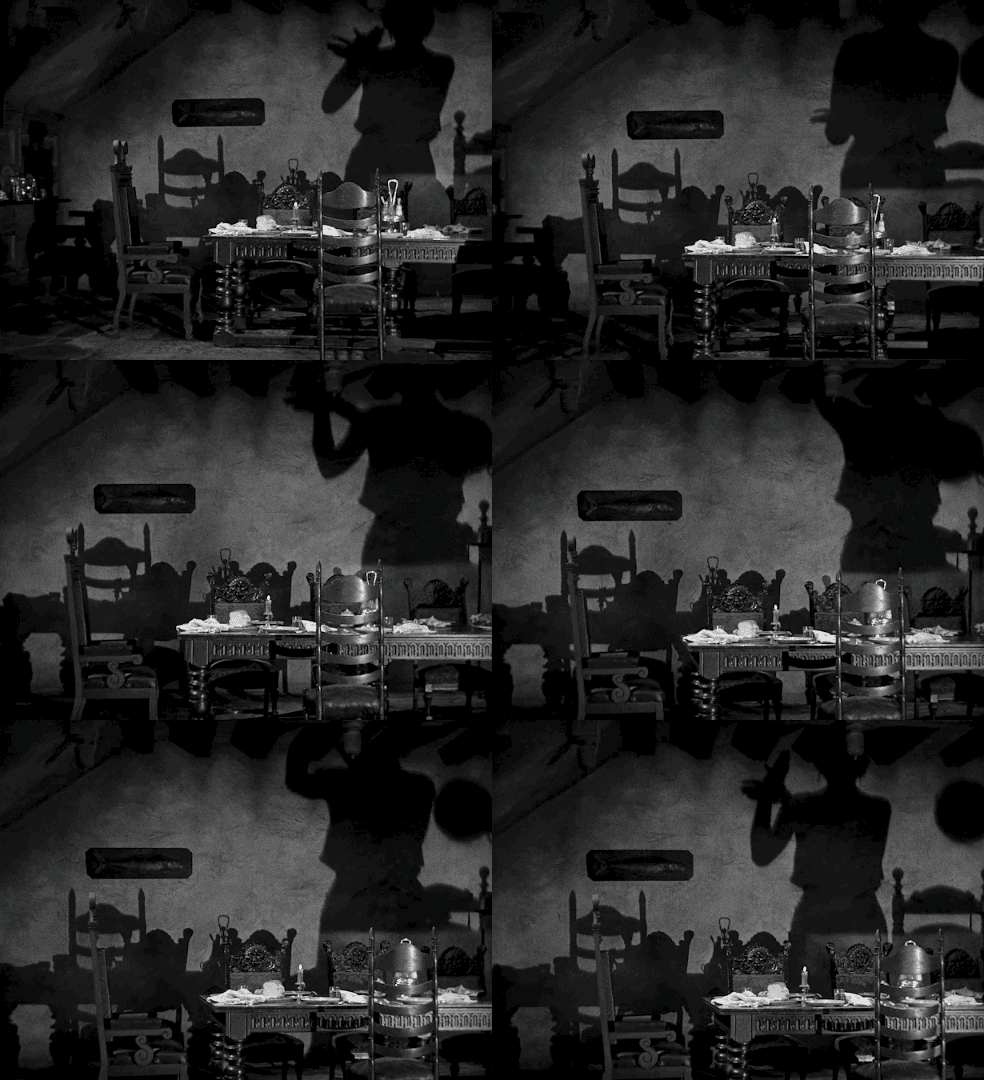
It’s soundtracked by a near-constant rumble of thunder and shrieking, piercing winds, so feels like Halloween all over. A remake in 1963 by schlock entrepreneur William Castle, released by Hammer Films, heavily reworked virtually every element of the story bar the general setup. It wasn’t warmly received, but it did help kickstart a renaissance of Whale’s original film in the 1960s that helped bring it back into public consciousness, where it gained a rightful reputation as a key influence on a whole subgenre of creaky old houses and the benighted denizens within. Speaking of which…
The Old Dark House is available on Eureka! 4K Blu-ray, or free to stream on YouTube.
10pm
Spider Baby: or, the Maddest Story Ever Told (1967) 80m
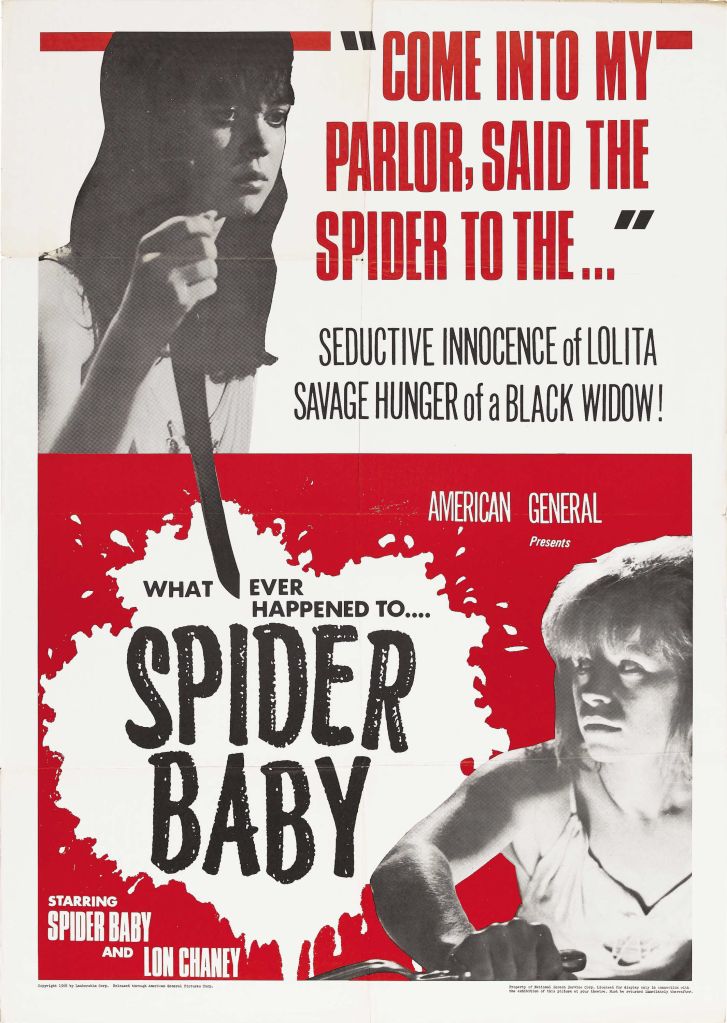
“This has gone well beyond the boundaries of prudence and good taste.”
Schlocker, Spider Baby
Director Jack Hill’s first solo directorial credit was originally shot over just 12 days in 1964, shortly after Hill had completed some uncredited work on both Roger Corman’s The Terror, and The Wasp Woman, along with co-directing a couple of ultra-low-budget features. However, the inexperienced real estate developers and novice film producers who provided the funding for this project fell into bankruptcy, marooning the film for 3 years until an eventual release in late 1967 saw the film taken up as the ‘filler’ half of drive-in double bills, as black and white movies had fallen out of favour within that relatively brief period, reducing its value.
But after passing into the public domain, a second life dawned from the video and late-night TV era, its cult expanding alongside those of both Hill and the several of the cast, especially Sid Haig as he returned to prominence in the 2000s with his Rob Zombie collaborations. Its continued profile reflective of a film that is bracingly subversive and somewhat deserving of its subtitle as, maybe not the maddest story ever told, but certainly mad enough to act as the wild centrepiece to this triple bill.
The film opens with an on-screen framing device, as we’re read details about the unfortunate case of the Merrye family, whose eponymous syndrome sees the offspring of the family begin developmentally regressing during adolescence – back through childhood and, potentially, beyond to a pre-human state of savagery and cannibalism. Our narrator tells us that, despite the scepticism of some in the medical profession, he knows only too well how real it is, as he leads us back a decade into the past. There, a postal messenger calls out to a couple of scrapping kids on their front lawn to ask them for directions to the Merrye estate, whereupon their mother gathers them up in a panic and, dragging them back to their home, lets him know that even if there were such a place, they’d certainly have nothing to do with it.
Eventually he trundles his trike down a hidden pathway to a dilapidated, rusty gate that leads him up an overgrown driveway up towards an imposing, shabby Queen Anne mansion. As he explores and calls out, he pokes his head through an open window – which immediately slams shut, trapping him helplessly. A dark-haired girl, shadowy eyes bored into her pale, round face, skitters into view in a ghostly white dress and bare feet. She scampers towards him, a large knife clutched in each fist and a rope net strung between. After slinging the net over his prone head and announcing that it’s time for the spider to give the bug a big sting, she grins widely and unleashes a brutal volley of wild slashes, hacking pieces off the old man.
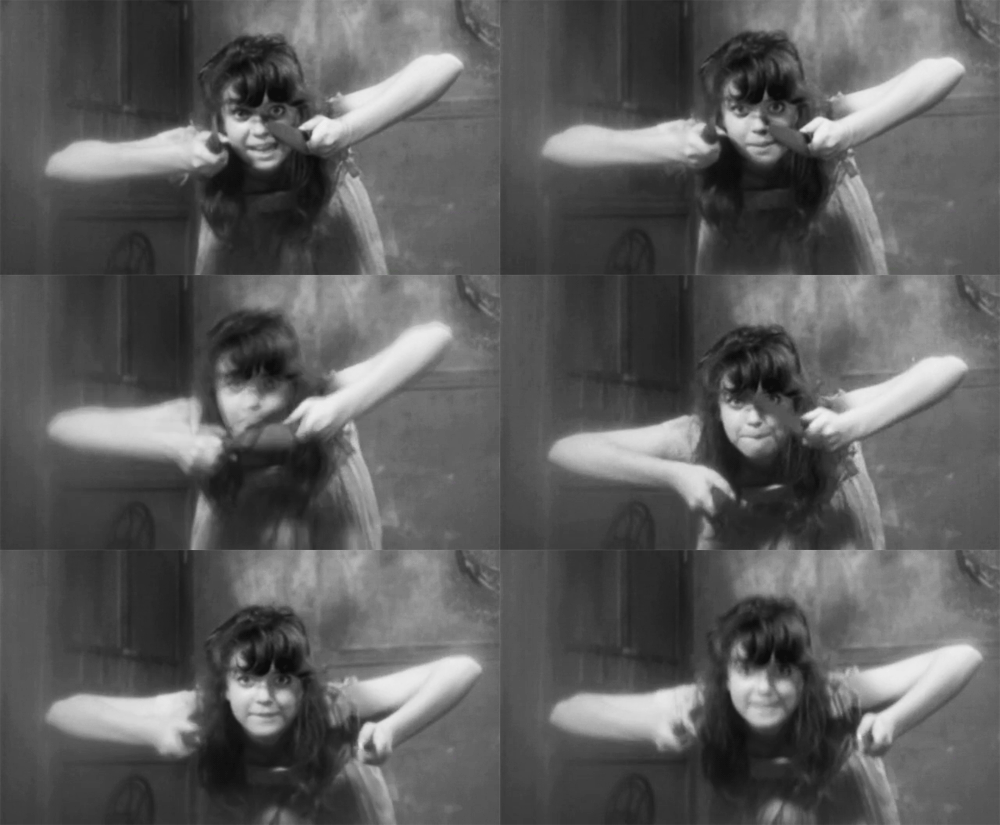
She’s interrupted by the arrival of another teen – blonde, with pigtails, in a neat, sensible outfit. “You’re bad! Bad! Bruno’s going to hate you!” she chides, as the violence dissipates from the first girl’s face which falls into a sulk. We meet Bruno, played by the Wolf Man himself, Lon Chaney Jr., piloting a gigantic 1930s limousine up to the house. Pausing to examine the abandoned messenger bike, he drives up to the house with concern, calling out to Elizabeth, the prim blonde, and Virginia, the wild brunette. The two quarrel, each blaming the other for Virginia’s violent outburst that doesn’t seem to surprise Bruno, so much as inspire a jaded chagrin. Virginia giddily rushes to the car instead, to see their brother Ralph – Sid Haig’s lanky form curled up on the floor of the vehicle with his thumb lodged in his mouth, springing to a joyous hyperactive state as his sister winds him up.
Here are the last generation of the once-prominent Merrye family, victims of generations of inbreeding, with their regression advancing apace as eldest son Ralph has the affect of a six-foot-plus toddler, and his sisters read more like troublesome primary schoolers with their squabbling and tattling. Bruno, we learn, is their father’s driver, who swore to care for the children and is the weary-eyed but sweetly indulgent keeper of their bizarre ways. This is not the first game of ‘spider’ he has had to deal with. But the body of this postal worker must be dealt with, as his telegram brings uncomfortable news – a pair of distant cousins, siblings Emily and Peter Howe, the last living branch of the family tree not incapacitated by the family curse, are coming to visit with the intention of taking the children as their wards.
Thus the wildly dysfunctional but caring makeshift family unit is disrupted, as the haughty, vain Emily (played by stunning one-time Paramount bombshell Carol Ohmart in the latter part of her relatively brief career) and the more likeable Peter (our narrator, essayed by a cheerfully goofy Quinn Redeker) bring along supercilious, cigar-chomping lawyer Schlocker and his sweet-natured secretary Anne to kickstart efforts to have the children institutionalised and take ownership of the estate and whatever remains of the family fortune. Bruno pleads with them that he would be breaking his pledge to their father, but Emily and Schlocker insist on staying overnight in the gloomy house to assert their rights.
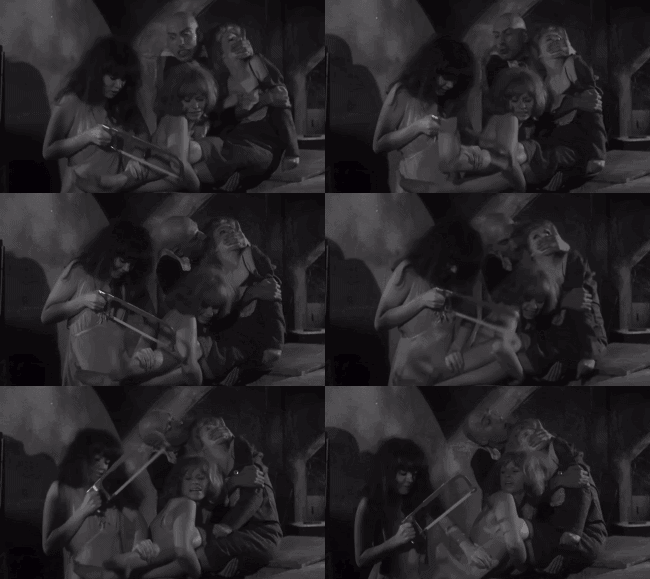
The concurrent popularity of humorously horror-adjacent monochrome TV sitcom clans like The Munsters and The Addams Family – both of which kicked off the same year this film was shot – offer a point of reference for our story of a group of normies finding themselves in the lair of a monstrous, close-knit family in a reverse tale of fish out of water. But both of those families were sweetly oblivious, oddball charmers where the gag was the horrified reactions of the squares who feared them. The Merrye kids, by contrast, are a menace and a genuine threat. As Bruno frets over preparing dinner for the unwelcome interlopers he still feels duty-bound to be courteous to, Veronica feeds her bureau full of tarantulas, and hunts bugs to serve alongside the ‘salad’ of twigs and moss. Ralph, dressed up in a ludicrously snug Little Lord Fauntleroy outfit for the occasion, has snagged a stray cat to roast whole – meat is a luxury in the house as eating it could accelerate the children’s condition. Meanwhile, Bruno sweats and panics about the undisclosed, dangerous inhabitants that lurk and moan in a cavernous basement beyond the hidden door behind the false pantry wall.
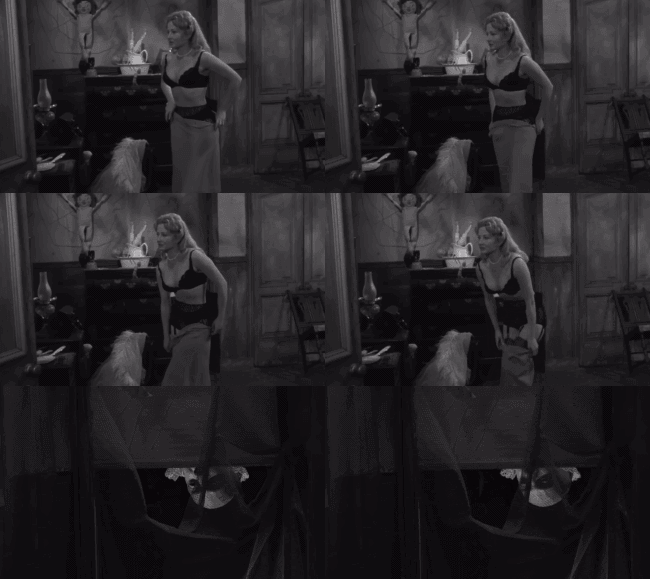
As night falls, Peter and Anne are dispatched to find a local motel due to a lack of suitable bedrooms. Emily takes residence in a grand, mouldering chamber and proceeds to preen and pirouette in the mirror wearing incredibly elaborate lingerie. Schlocker goes searching for answers to the many macabre mysteries of the house, which ends about as well as you could expect. The creepy mayhem that ensues as the children start turn the tables on Aunt Emily and Uncle Peter has been described as comedy-horror, which I think is apt – there’s a blackly humorous streak running through the whole film, a tone established with the adorable credits song performed by Lon Chaney Jr. (that was covered by alt rock legend Mike Patton’s band Fantômas on their stone cold classic album The Directors Cut). But this is not the kind of comedy that offers winking relief from the unsettling atmosphere: the weirdness does not let up, and comes charged with a genuine sense of pathos due to Chaney’s soulful performance of a dutiful, caring, but unstable man coming to terms with the increasing impossibility of the Merryes’ circumstances. It’s not just Chaney – the whole cast commit wonderfully, and Hill is a phenomenal talent, imbuing this low budget oddity with charm, edge, and technical prowess. It’s spooky, funny, sharp, and fits perfectly as a bridge between James Whale’s sly formal brilliance, and the upcoming film’s more outré grotesquerie.
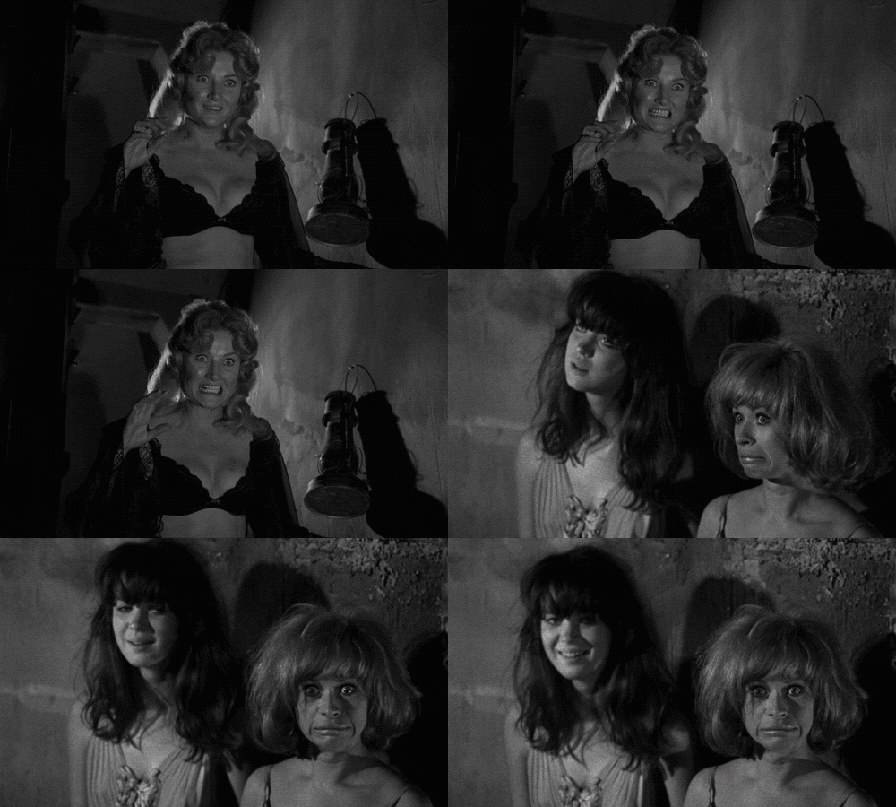
Incidentally, after Spider Baby’s underwhelming release into the world, Hill moved on to a brief but fascinating career, including co-directing 4 cheap Mexican horrors with Boris Karloff in the space of a single year, and an all-timer run with Pam Grier that culminated in Coffy and Foxy Brown. Unfortunately it all ran aground after he split with his long-time mentor and patron Roger Corman during the disastrous production of the cheapo swords-and-sorcery flop Sorceress in 1982, and he hasn’t directed since.
Spider Baby is available on Arrow Blu-ray in the UK (out of print, but available second hand). Stream for free on The Internet Archive.
Midnight
The People Under the Stairs (1991) 102m
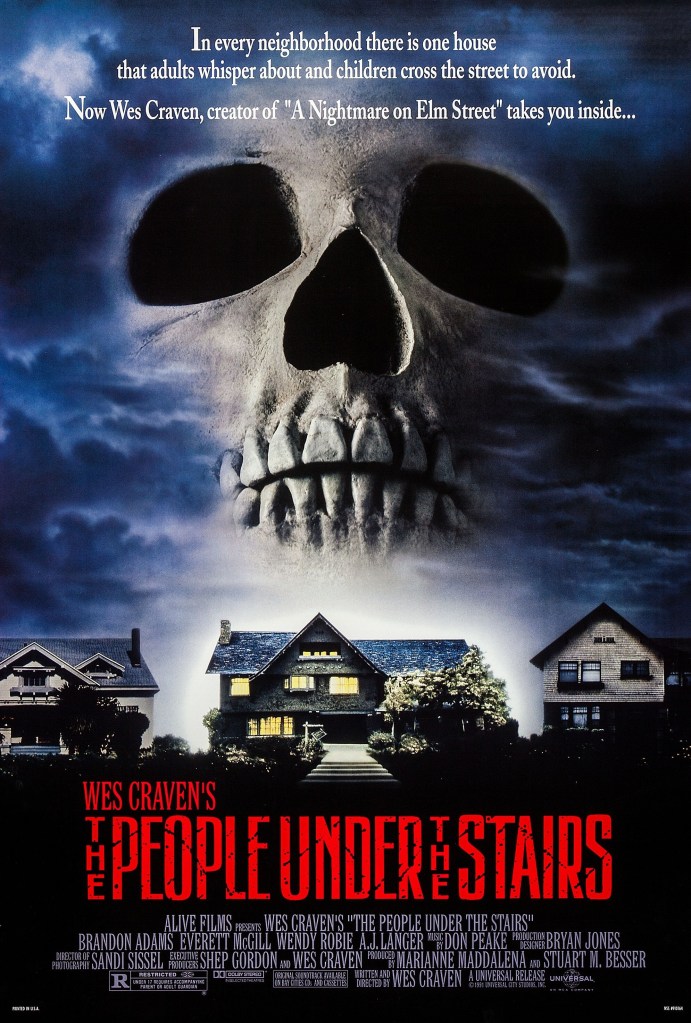
“Thirteenth birthday is unlucky anyway. Too old to get tit, too young to get ass… fucked either way.”
Leroy, The People Under the Stairs
I was always under the impression that Wes Craven was floundering between the phenomenal success of A Nightmare on Elm Street and Scream’s slasher-rejuvenating return to form. Which is, honestly, maybe fair – The Hills Have Eyes Part II was an unfinished wreck dumped into cinemas for a quick buck; Deadly Friend and Shocker were little loved by critics or audiences; the smart The Serpent and the Rainbow fared better, but was always too grim to blossom into a smash hit; Vampire in Brooklyn was deemed another overblown misstep for a floundering Eddie Murphy; while Wes Craven’s New Nightmare, still a financial failure, was at least a canny genre riff that showed signs of Craven’s self-reflexive smarts that would see him regain his reputation as a horror icon two years later with the aforementioned Scream.
Stuck right in the middle of this torrid run is our final film of the evening, our midnight special – 1991’s The People Under the Stairs, which opened at the top of the box office and eventually pulled more than 5 times its thrifty budget while reaping respectable reviews, bucking the trend of a lengthy slump for Craven. This was a new discovery for me – I knew I wanted a modern film, preferably in the 1990s so I could keep three-decade intervals throughout the night. So I went ahead and tentatively programmed this sight unseen, as it had long been on the watchlist. Thankfully, it’s a bit of a gem, and perfectly aligned with the films that come before it while bringing a new flavour to the ghoulish buffet.
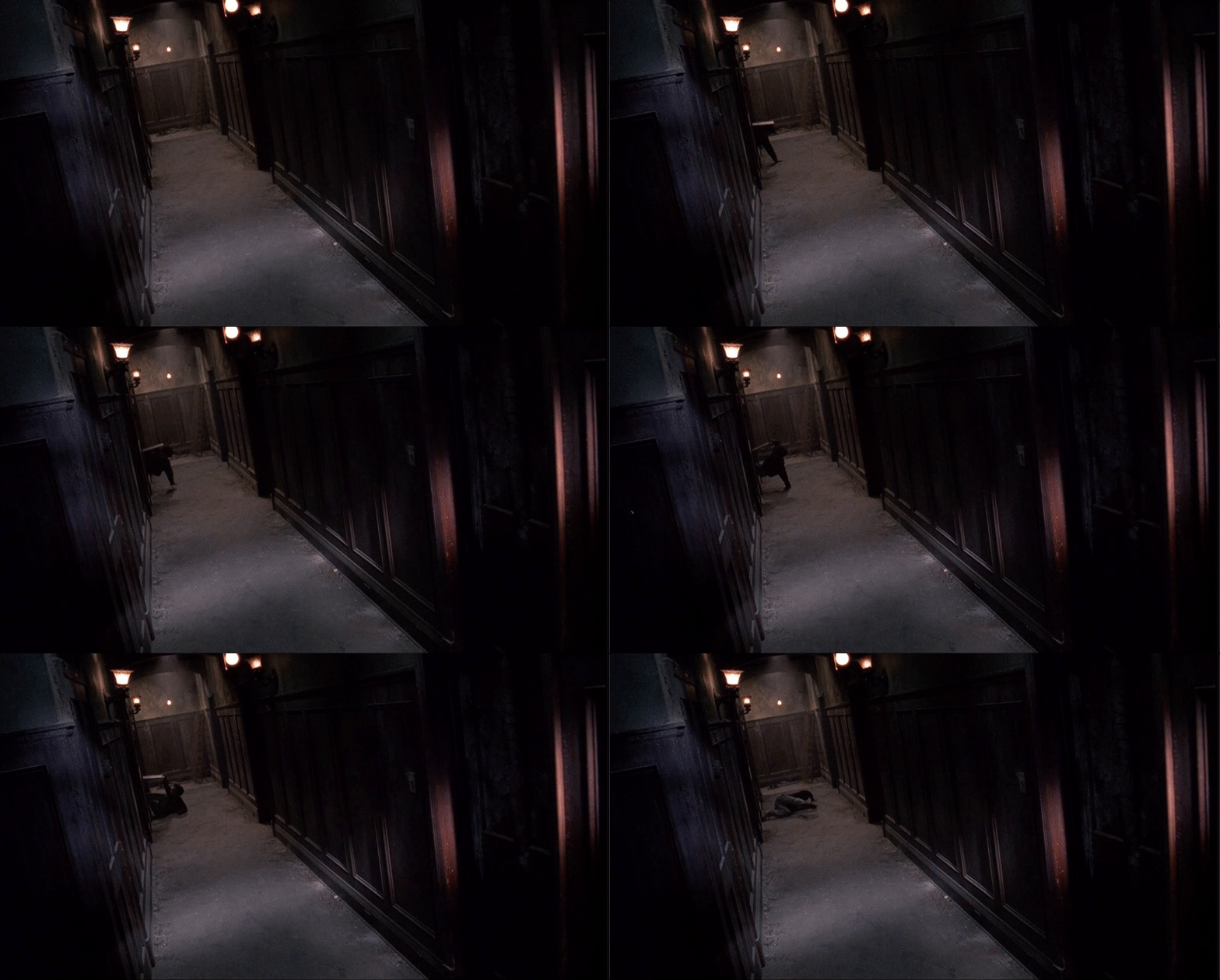
Somehow, the film manages to be both a gothic housebound horror of a lineage with The Old Dark House and Spider Baby, with its murky corridors and fucked up siblings and appropriately Halloween-ish sense of outlandish macabre, while also belonging to a fascinating not-quite genre: the 1990s Los Angeles-set socially conscious race relations drama. As Black America broke through to mainstream white media, with Spike Lee’s Do The Right Thing over on the East Coast helping break down barriers that allowed the likes of John Singleton and the Hughes Brothers to spin gritty narratives out West, with the concomitant emergence of the likes of Public Enemy and N.W.A. as brutally poetic storytellers, studios had a weird and bewildering time working out what to do with all this new information. As we know, Hollywood is nothing if not fascinated with itself, so while black filmmakers like Lee, Singleton, and the Hugheses took the opportunity to tell stories of the tensions and struggles in the community with verisimilitude and fire, well-meaning, but possibly naïve white filmmakers started weaving takes on California’s torrid race relations into seemingly unrelated genre fare. One of my favourite examples is British docudrama legend Mick Jackson’s Volcano, where the story of craggy Tommy Lee Jones trying to stifle a city full of lava also has a lot on its mind about the aftermath of the 1992 riots.
Craven is ahead of the curve here. His narrative starting point is, if we’re being critical, a fairly typical example of what we’d now call poverty porn. Newly-turned 13-year-old Poindexter Williams, or “Fool” to his family, a nickname derived from his sister’s Tarot readings positioning him, like the card, on the cusp of adulthood and the loss of childhood innocence, lives in the last remaining rundown apartment of a condemned block in the ghetto. His sister, young and with children of her own and possibly making ends meet via sex work, lives with him and their cancer-ridden, bed-bound mother. An acquaintance of hers, Leroy (a brilliant Ving Rhames) arrives with a proposition – Fool is now old enough to help him rob the house of the proprietors of the local liquor store that’s rumoured to contain an antique gold coin collection that can stave off their impending eviction, and save their mother through available, but currently unaffordable, medical treatment.
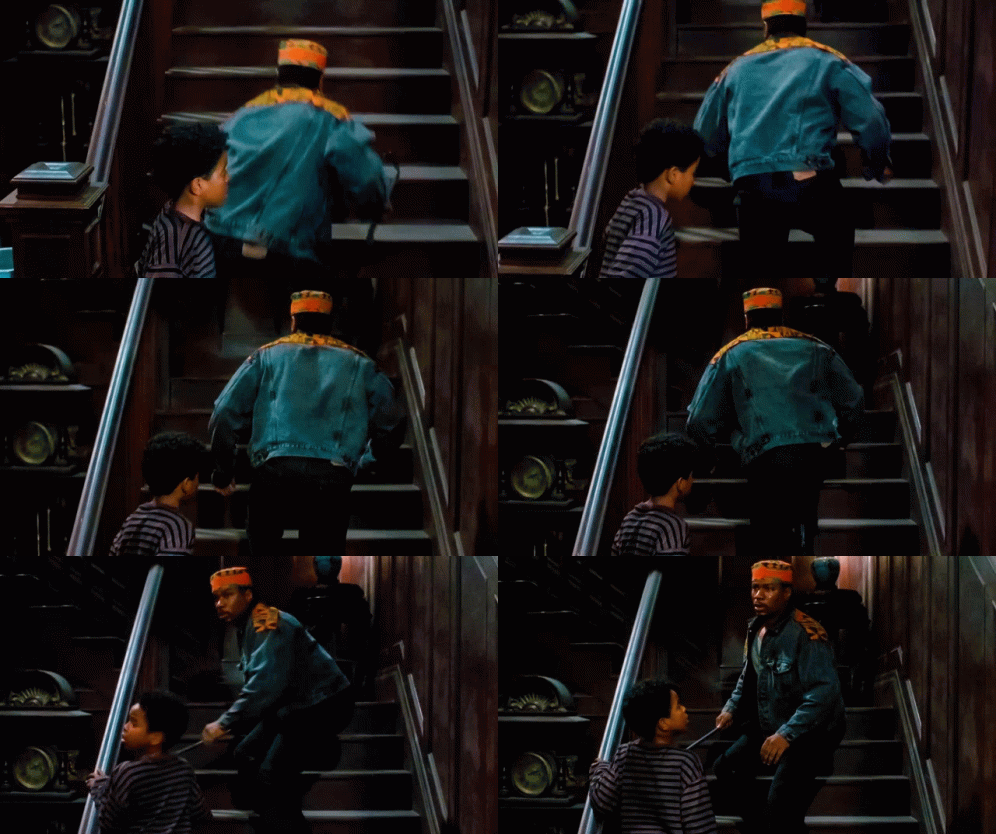
What marks Craven’s film out from some of the dafter LA race tales of the era is his horror filmmaking smarts, his palpable ideological disgust at social iniquity and deprivation, and his goofy savagery in how he confronts this. Fool is a true innocent, a protective, emotional kid who wants to do anything he can to help his mother’s situation. He takes on a classic quest, a near-mythic journey to battle through monsters to retrieve literal gold for his family’s betterment. He travels with his guide Leroy, flawed though he is, across the Rubicon to the castle. In this case, that’s the home of the Robesons, or Mommy and Daddy as they insist on calling each other – a vast, dark, locked-down house some distance from Fool’s deprived neighbourhood. Fool and Leroy travel with a third thief, Spenser, with Fool deployed as a literal and metaphorical Scout to scope out the property while masquerading as a charity cookie seller. When he fails to access the property, Spenser dresses as a gas repairman and finagles his way in – although it is clear that Mommy has clocked his counterfeit ID card.
Leroy and Fool are concerned when Spenser fails to return to their van when Mommy drives away from what now seems like an empty house – Fool for the man’s wellbeing, Leroy that he has taken off with the spoils himself. So, in they go, to a dazzling, grimy horror maze that will be our setting for the remainder of the running time. One of Craven’s first strokes of genius is in lifting whole cloth from David Lynch’s then-current satire of American weirdness, Twin Peaks, in casting Big Ed and Nadine (Everett McGill and Wendy Robie) as the mad Robesons. They keep their young daughter in brutal, God-fearing, violent coercive control – a princess trapped in the tower – and they, like the Merrye’s have something to hide in the basement. And something, or more specifically someone, hiding from them in the walls.
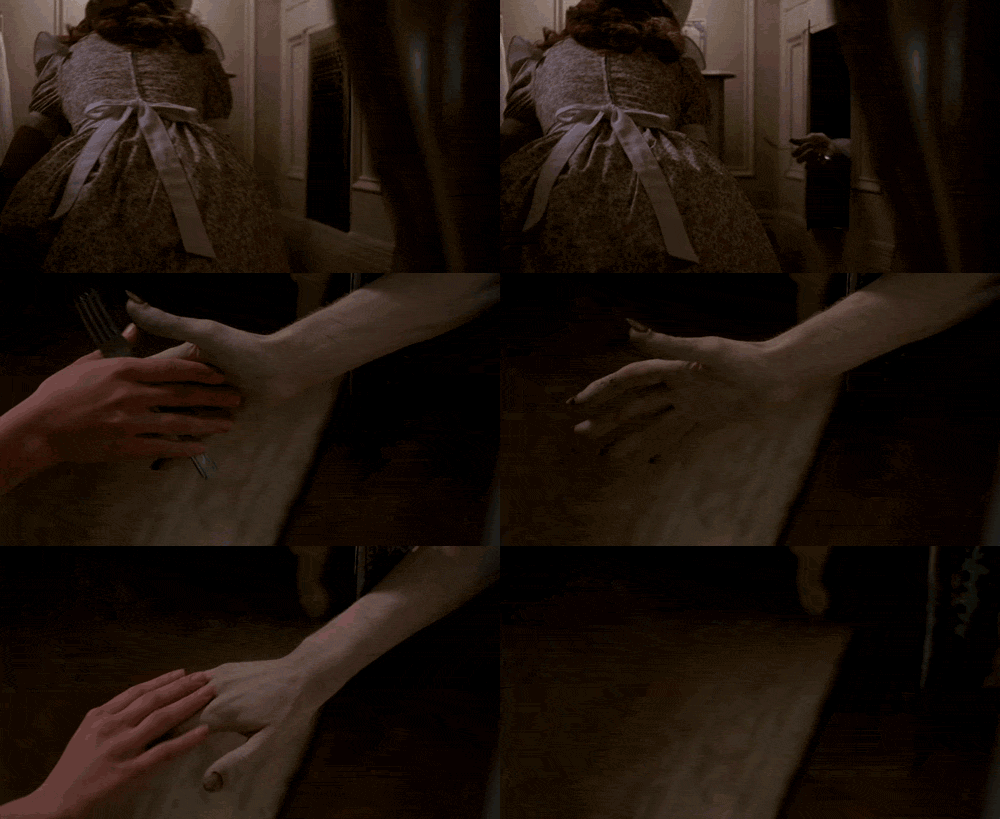
The Robesons represent the grotesquerie of the rich and powerful, depicting them as disgusting, insular perverts who see other people as, at best, miserable functions by which to gain themselves more power and money, and more often, as parasites to be snuffed out. They represent the brutality and hypocrisy of the Reagan ‘80s, where God-fearing, respectable bastions of white capitalism hoard resources at the barrel of a gun while decrying and slandering the people they are vampirically feasting upon as predatory landlords. They revel in the hunt of Leroy and Fool, setting loose their Rottweiler in scenes which Craven surely intended to evoke memories of the brutal segregation of the Jim Crow South. And the titular people under the stairs are of course an unsubtle metaphor for the violence inherent in maintaining a class structure that keeps people like the Robesons on top.
But all this high-minded allegorical discussion of the quest narrative and the depiction of the intersection of racism and conflict between social and economic classes isn’t quite describing what a bizarre, wacky watch this film actually is. We haven’t really touched on a lot of early 1990s horror in our podcast, other than Tobe Hooper’s ill-gotten The Mangler, which also came with a weird vibe. In People under the Stairs there’s a holdover of the 1980s glory days of practical effects and production design – rubbery make up, squibs aplenty, elaborate trick-laden sets – but there’s a saturation to the colour and a hyperactive use of movement and over-reliance on ultra-wide angle lenses that feels very, I don’t know, The Adventures of Pete and Pete but with more graphic torture and murder? Where the comedy in The Old Dark House comes through slyly and subtly in moments of dry drawing room wit in long, wide takes, and in Spider Baby is shot with the grainy efficiency of drive-in B-movie exploitationers, here there is an unmistakably early ’90s maximalism that didn’t really seem to exist just a couple of years before. McGill and Robie especially are turned up to 11, yelling and gurning and jigging and occasionally marauding in a full gimp suit while the camera careens around them in a manner that suggests that the usually stolid craftsman Craven had seen some of that young whippersnapper Sam Raimi and been inspired.
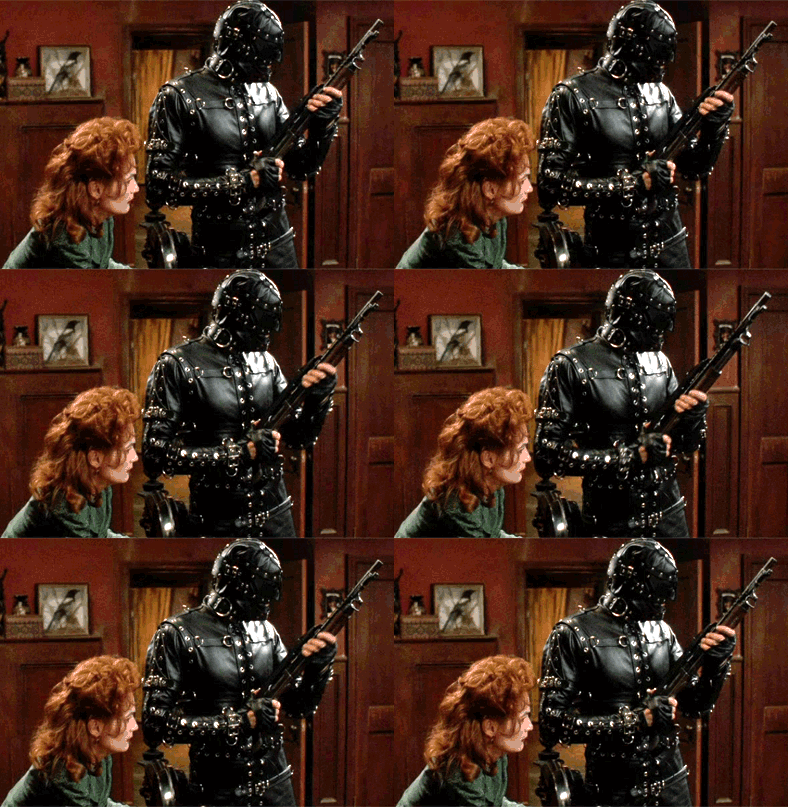
The finale goes big, thankfully, in ways which it would be a shame to spoil here. In common with the preceding films tonight is that subversive slant on wealth and isolation, and the revealing of the unpleasant oddness behind the innocuous doors that could lurk right in your own town. And importantly, there’s also that refreshing unpredictability as to where this is all going while you watch all of these films play out. Craven’s control on the tone and pacing isn’t perfect, but that jagged strangeness powers the film through some occasionally repetitive set pieces and logical lapses. And if you can get on its wavelength, the juxtaposition of fraught tension, threatened brutality, and daffy slapstick can induce a baffled glee that works wonders after a night of pick and mix and ill-advised seasonal imperial stouts. You wouldn’t want to trick or treat either the Femms or the Merryes, but the Robesons would be the worst of all. While I won’t spoil their fate, there’s a mad satisfaction to be had before rappers Redhead Kingpin & The F.B.I. close proceedings with the gloriously 1990s, aptly-titled rap track Do the Right Thing over the closing credits.
The People Under the Stairs is available on Blu-ray from Arrow, 4K via Scream Factory, and to rent/buy from most major digital platforms.
Carefully curated from our extensive archive of Rewind Movie Podcast selections over the years, we also offer you our Letterboxd list—The Best of Hallore’ewind: Tricks + Treats 🍬 31 indispensable HalloRe’ewind go-tos to last you an entire HorrOctober! 🎃
The camp is closed, the old dark mansion’s creaky doors are all locked once more, and we must good you a bid evening. Feel free to travel back through the ages to our 2025 trilogies, our 2023 quadruple bills, Matt’s 2022 marathon, our exhaustive, inaugural 2020 iteration, and Devlin’s original, bum-numbing 2018 all-dayer.
Until the next time, Happy HalloRe’ewind, Rewinders! Sleep tight.
Listen on Spotify
Listen on Apple Podcasts
Listen on Amazon Music
Listen on Deezer


Leave a Reply